
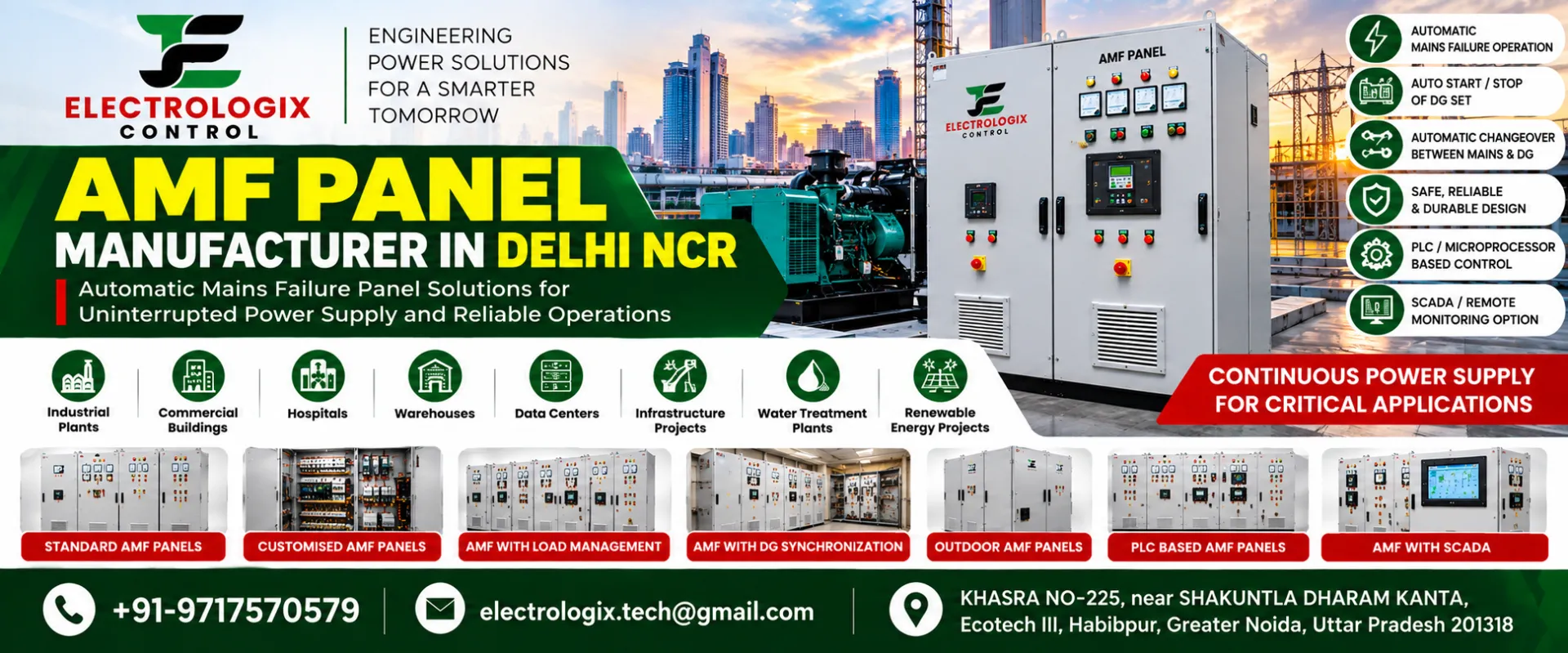
Electrologix Control System is an AMF Panel Manufacturer in Delhi NCR, providing Automatic Mains Failure panels for industrial, commercial, institutional, infrastructure and backup power applications.
An AMF panel, or Automatic Mains Failure Panel, is an electrical control panel designed to monitor the utility mains supply and coordinate the operation of a diesel generator when the mains supply fails. Depending on the system configuration, the AMF arrangement can automatically initiate the DG set, transfer the electrical load to the generator after suitable conditions are established, and transfer the load back to mains when the utility supply is restored.
Electrologix Control System manufactures and supplies Automatic AMF Panels along with DG Synchronizing Panels, PCC Panels, MCC Panels, PLC Control Panels, Distribution Panels and other electrical control solutions. The company is based in Greater Noida, Uttar Pradesh, serving customers across Delhi NCR and nearby industrial regions.
What Is an AMF Panel?
AMF stands for Automatic Mains Failure.
An AMF panel is used with a generator system to automate the response to failure or restoration of the normal electrical mains supply.
A typical AMF sequence works as follows:
Mains Available → Load on Mains → Mains Failure Detected → DG Start Command → DG Voltage/Frequency Stabilized → Load Transferred to DG → Mains Restored → Load Transferred to Mains → DG Cool-Down/Stop
The exact sequence, timers, interlocking and protection functions depend on the generator, controller, switching equipment and project requirements.
Government and institutional electrical specifications commonly describe AMF systems with functions such as mains-failure monitoring, start/stop control, restoration timers, protection, metering and Auto/Manual/Test modes.
AMF Panel Manufacturer in Delhi NCR
Electrologix Control System is a Greater Noida-based electrical panel manufacturer and supplier. Its published product range specifically includes Automatic AMF Panels, along with Distribution Panels, Automatic MCC Panels, PLC Control Panels, DG Synchronizing Panels, Automatic Capacitor Panels and Automatic PCC Panels.
Its manufacturing location in Ecotech-III, Greater Noida, places the company within the Delhi NCR industrial region and allows it to address electrical panel requirements for customers in:
- Delhi
- Noida
- Greater Noida
- Ghaziabad
- Faridabad
- Gurugram
- Manesar
- Dadri
- Jewar
- Nearby industrial areas of Uttar Pradesh and Haryana
How Does an AMF Panel Work?
The primary function of an AMF panel is to coordinate the electrical system during a mains failure and restoration.
Step 1: Monitoring the Mains Supply
The AMF controller continuously monitors selected parameters of the mains supply, such as voltage and phase conditions, according to the system design.
Step 2: Detecting Mains Failure
When the mains supply falls outside the configured operating conditions, the controller identifies the failure after the programmed detection or delay period.
Step 3: Sending the DG Start Command
The AMF controller sends a start command to the diesel generator control system.
Step 4: Checking Generator Availability
After the DG starts, the control system verifies that the generator has reached suitable operating conditions before transferring the load.
Step 5: Transferring the Load
The switching arrangement transfers the load from the mains source to the DG source after the required interlocking and electrical conditions are satisfied.
Step 6: Monitoring DG Operation
The AMF system can monitor relevant electrical and generator conditions and respond to configured fault or protection signals.
Step 7: Detecting Mains Restoration
When the normal utility supply returns and remains stable for the configured restoration period, the system initiates the return sequence.
Step 8: Transferring Load Back to Mains
The load is transferred from the generator back to the normal mains supply through the configured switching arrangement.
Step 9: DG Cool-Down and Stop
Where supported by the generator control logic, the DG can run for a programmed cool-down period before receiving the stop command.
The actual operating sequence should be finalized according to the DG manufacturer’s controller, switching equipment and project electrical design.
AMF Panel and ATS: What Is the Difference?
AMF and ATS are related but are not always identical terms.
An Automatic Transfer Switch (ATS) primarily handles automatic transfer of a load between available power sources.
An AMF system additionally incorporates logic associated with mains-failure detection and automatic generator starting and stopping.
In a DG backup installation, the complete system may therefore include:
Mains Monitoring + DG Start/Stop Control + Automatic Source Transfer + Electrical Interlocking + Protection + Metering
The exact architecture depends on whether these functions are integrated into one panel or distributed between an AMF controller, ATS equipment and the DG’s own control system.
Main Components of an AMF Panel
The components depend on the DG capacity, switching arrangement, protection requirements and project specification.
AMF Controller
The controller is the central logic unit responsible for monitoring inputs and executing the programmed mains-failure and generator-control sequence.
MCCB or ACB
Circuit breakers can be used for incoming and outgoing power switching and protection according to the panel design.
Contactors or Motorized Switching Devices
Depending on the panel rating and architecture, contactors or electrically operated breakers can be used for source transfer.
Auxiliary Relays
Relays provide electrical interfacing between the AMF controller, generator controller, breakers, contactors and external signals.
Timers
Timers or programmable controller functions can provide delays for mains failure detection, generator starting, source transfer, mains restoration and DG cool-down.
Voltage Monitoring
Voltage monitoring allows the controller to identify abnormal or failed mains conditions according to configured thresholds.
Frequency Monitoring
Generator frequency can be monitored to determine whether the DG has reached acceptable operating conditions for load transfer.
Indication Lamps
Visual indications can show conditions such as:
- Mains Available
- DG Available
- Mains ON
- DG ON
- DG Running
- Common Fault
- Auto Mode
- Manual Mode
- Trip
Selector Switches
Common operating modes may include:
- Auto
- Manual
- Test
- Off
The actual controls depend on the project specification.
Emergency Stop
An emergency-stop arrangement can be incorporated where required by the DG and electrical system design.
Metering Instruments
The panel can include electrical meters or multifunction meters for monitoring parameters such as voltage, current, frequency, power and energy, depending on the application.
Types of AMF Panels
AMF panels can be configured in different ways depending on the electrical installation.
Single DG AMF Panel
Designed for installations using one diesel generator as the standby power source.
AMF Panel with ATS
An AMF controller can be integrated with an automatic transfer arrangement to coordinate generator starting and automatic load transfer.
AMF Panel with MCCB
MCCB-based switching arrangements can be used for suitable current ratings and system configurations.
AMF Panel with ACB
For higher-capacity systems, ACB-based switching arrangements may be selected according to the electrical design.
AMF Panel with PLC
PLC-based control can be considered when the project requires customized automation, additional logic or integration with a larger control system.
AMF Panel with Remote Monitoring
Where required, communication and monitoring interfaces can be incorporated for integration with SCADA, BMS or other monitoring systems.
AMF Panel for Multiple DG Systems
Installations using multiple DG sets may require a synchronization and load-management system rather than a basic single-DG AMF arrangement.
Electrologix also manufactures DG Synchronizing Panels for applications involving multiple generators and power management. Its published product information describes automatic/manual synchronization, voltage/frequency/phase matching, load sharing, protection and SCADA integration.
Applications of AMF Panels
AMF panels are useful wherever electrical loads require automatic backup power operation.
Manufacturing Plants
Factories often depend on continuous electrical operation for production machinery, automation systems, pumps, compressors and utility equipment.
Commercial Buildings
AMF systems can be used with DG backup systems serving offices, shopping facilities, hotels and other commercial buildings.
Hospitals
Healthcare facilities may require automatic generator operation for selected essential electrical loads.
Data and IT Facilities
Backup generation can form part of a broader power-resilience architecture for critical IT infrastructure.
Warehouses
Warehouses can use DG-backed electrical systems for lighting, material handling, security systems and other critical equipment.
Water Treatment Plants
Pumps, blowers, control systems and other water-treatment equipment can be supported by DG backup systems.
Educational Institutions
Schools, colleges and universities can use generator-backed power systems for essential electrical loads.
Infrastructure Projects
Infrastructure installations may require automatic generator operation for electrical systems located at remote or critical facilities.
Residential and Commercial Complexes
Large residential developments and commercial complexes can incorporate AMF systems with DG sets for backup power.
AMF Panel for DG Set
An AMF panel works closely with the diesel generator’s control system.
The interface between the AMF panel and DG set may include signals for:
- DG Start
- DG Stop
- DG Running
- DG Available
- Common Fault
- Low Oil Pressure
- High Coolant Temperature
- Overspeed
- Emergency Stop
- Battery Condition
- Generator Voltage
- Generator Frequency
The exact signal list depends on the DG manufacturer’s controller and the project requirements.
A proper interface design is important because the AMF panel and DG controller need to operate together without conflicting commands or unsafe switching conditions.
AMF Panel Protection Features
Protection requirements depend on the electrical system and project specification.
Possible functions can include:
- Overload protection
- Short-circuit protection
- Overvoltage protection
- Undervoltage protection
- Overfrequency protection
- Underfrequency protection
- Phase failure monitoring
- Phase sequence monitoring
- Earth-fault protection
- DG fault indication
- Emergency shutdown
- Breaker trip indication
Government electrical specifications for AMF systems can include protection and metering functions such as reverse power, earth fault, voltage monitoring and energy analysis depending on the application.
The protection scheme should be engineered for the actual electrical system rather than applying the same configuration to every project.
AMF Panel with PLC and SCADA
Industrial facilities may require generator operation to be monitored through a centralized automation system.
An AMF panel can be designed for communication with PLC, SCADA or BMS systems where appropriate.
Potential monitoring information can include:
- Mains status
- DG status
- Generator voltage
- Generator current
- Frequency
- DG running hours
- Fault status
- Breaker status
- Source availability
- Alarm conditions
Electrologix’s published panel range includes SCADA/PLC automation panels and intelligent/smart panel solutions, supporting broader industrial automation requirements.
Customized AMF Panel Manufacturing
Every DG installation has different requirements. The AMF panel should therefore be designed according to the generator rating, connected load, source arrangement and switching requirements.
Electrologix Control System can develop AMF panel configurations around requirements such as:
- DG kVA rating
- Load current
- Number of DG sets
- Mains supply
- Generator supply
- MCCB or ACB requirement
- Switching arrangement
- Controller type
- Protection scheme
- Metering
- Control voltage
- Cable entry
- Panel dimensions
- Indoor or outdoor installation
- Remote monitoring
- PLC/SCADA integration
- Manual and automatic operating modes
AMF Panel Selection Guide
Before selecting an AMF panel manufacturer, provide the following technical information:
DG Capacity
Specify the generator rating in kVA and the generator manufacturer’s details.
Connected Load
Provide the expected connected load and identify critical and non-critical loads where applicable.
Electrical System
Specify the mains voltage, number of phases and frequency.
Switching Rating
The incomer and transfer switching equipment should be appropriately selected according to the load current and electrical design.
DG Controller
Identify the existing DG controller and available remote-start/stop and status signals.
Protection
Define the required protection functions and coordination with upstream/downstream protection.
Metering
Specify whether voltage, current, frequency, energy, power factor or other parameters need to be displayed.
Communication
If remote monitoring is required, specify PLC, SCADA, BMS, Modbus or other communication requirements.
Installation Environment
Indoor/outdoor location, enclosure requirements, ambient conditions and cable-entry arrangements should be considered.
AMF Panel Manufacturing and Quality
Electrologix Control System states that it manufactures electrical panels using optimum-grade components and subjects products to multiple quality checks before supply. The company also states that it maintains ISO-certified processes and has CPRI and TUV type-tested certificates for relevant products.
Its published panel information also describes modular and bolted construction, busbar design, gasketed construction and finger-touch protection features for applicable panel configurations.
For AMF applications, quality should be evaluated not only on the enclosure and components but also on:
- Correct control logic
- Source interlocking
- Generator interface
- Protection coordination
- Internal wiring
- Terminal identification
- Functional testing
- Indication and alarm operation
- Documentation
- Site commissioning requirements
Why Choose Electrologix Control System for AMF Panels?
Electrologix Control System is a Greater Noida-based manufacturer and supplier of electrical control and power panels. Its published product portfolio specifically includes Automatic AMF Panels and DG Synchronizing Panels along with PCC, MCC, PLC, Distribution and other electrical panel solutions.
For an AMF project, the technical discussion can cover:
- DG rating
- Mains supply
- Load requirement
- Automatic transfer arrangement
- Controller
- Protection
- Metering
- Generator interface
- Remote monitoring
- Panel enclosure
- Cable entry
- Site conditions
- Commissioning requirements
This helps ensure that the AMF panel is configured around the actual generator and electrical installation.
AMF Panel Manufacturer Serving Delhi NCR
Electrologix Control System’s works are located at Khasra No-225, Village Habibpur, Ecotech-III, near Shakuntla Dharam Kanta, Greater Noida, Uttar Pradesh. The company publishes +91-9717570579 and electrologix.tech@gmail.com as its contact details.
The company serves electrical panel requirements across the Delhi NCR region, including:
- Delhi
- Noida
- Greater Noida
- Ghaziabad
- Faridabad
- Gurugram
- Manesar
- Dadri
- Jewar
- Nearby industrial areas
Frequently Asked Questions
What does AMF stand for?
AMF stands for Automatic Mains Failure.
What is the main purpose of an AMF panel?
The main purpose is to monitor the normal mains supply and coordinate automatic DG starting and source transfer when the mains supply fails, followed by restoration to mains when normal supply returns.
Is an AMF panel required with a DG set?
Whether an AMF panel is required depends on the desired operating mode and electrical system. If automatic generator starting and automatic source transfer are required, an AMF/control and transfer arrangement is typically part of the system.
What is the difference between AMF and ATS?
ATS primarily performs automatic transfer between power sources. AMF additionally provides logic for detecting mains failure and controlling automatic DG start/stop. In some installations these functions are integrated into a combined system.
Can an AMF panel work with an existing DG?
It can be possible where the existing DG controller supports the required remote-start, stop and status interfaces. The exact compatibility should be checked against the DG controller and electrical configuration.
Can an AMF panel be customized?
Yes. AMF panels can be configured according to DG capacity, load, switching equipment, protection, metering, controller, communication and installation requirements.
Can AMF panels be integrated with SCADA?
Yes. Where supported by the controller and project architecture, communication can be provided for SCADA, PLC, BMS or other monitoring systems.
Can one AMF panel control multiple DG sets?
Multiple-DG installations generally require additional synchronization and load-sharing logic. A DG Synchronizing Panel may be appropriate depending on the system architecture.
Where are AMF panels used?
AMF panels are used with DG backup systems in factories, hospitals, commercial buildings, warehouses, institutions, infrastructure projects, utilities and other facilities requiring automated generator operation.
Where is Electrologix Control System located?
Electrologix Control System is based in Greater Noida, Uttar Pradesh, with its published works address in Ecotech-III, Habibpur.
Get a Customized AMF Panel
If you are looking for an AMF Panel Manufacturer in Delhi NCR, Electrologix Control System can evaluate your DG and electrical requirements and develop an appropriate AMF panel configuration.
For a technical enquiry, provide the DG kVA rating, mains voltage, connected load, switching requirement, DG controller details, protection requirements, metering requirements and any PLC/SCADA communication requirements.