
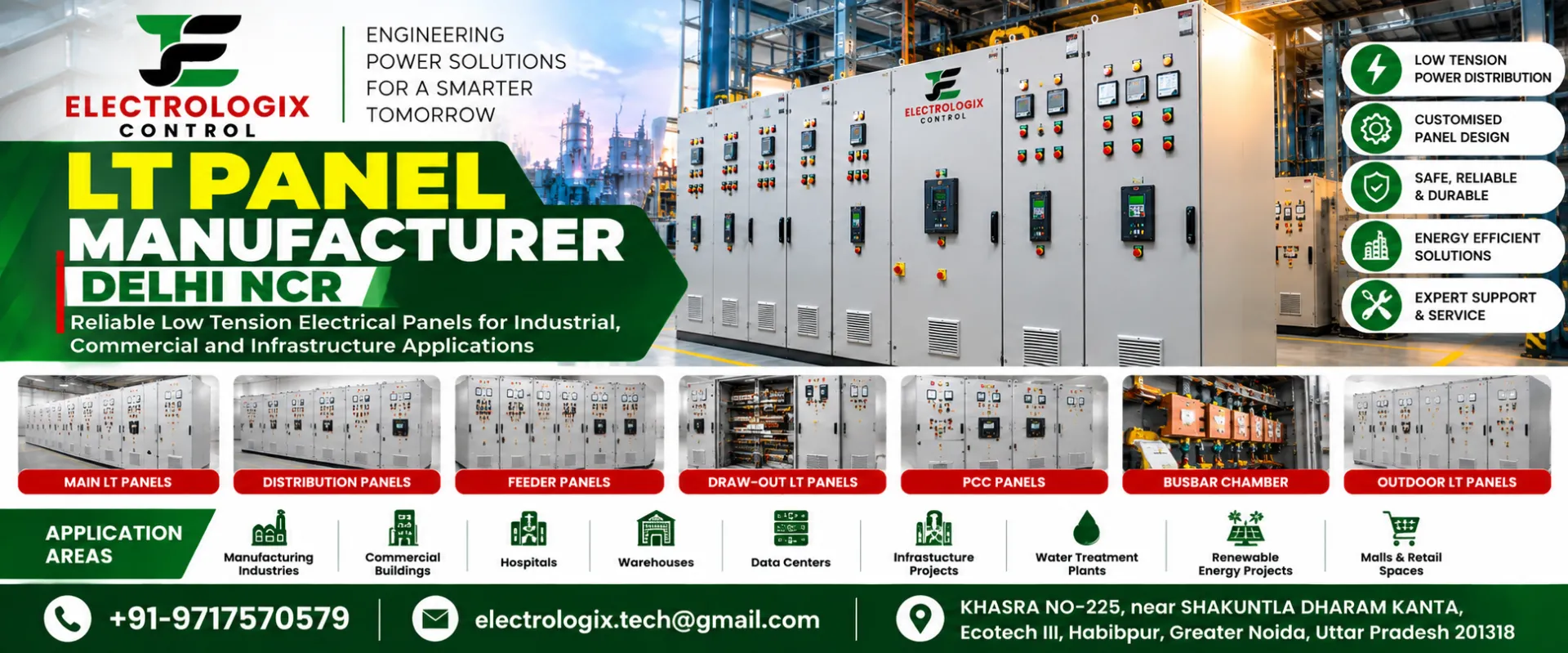
Electrologix Control System is an LT Panel Manufacturer in Delhi NCR, providing customized low tension electrical panels for industrial plants, commercial buildings, infrastructure projects, utilities, warehouses, institutions and other electrical installations.
LT panels, also known as Low Tension Panels or Low Voltage Panels, are used for electrical power distribution, switching, protection, control and monitoring within low-voltage electrical systems. Depending on the application, an LT panel can be configured as a PCC, MCC, distribution panel, feeder panel, AMF panel, APFC panel, VFD panel or other specialized electrical control and distribution system.
Electrologix Control System is based in Greater Noida, Uttar Pradesh, and its published product portfolio includes Distribution Panels, PLC Control Panels, Automatic MCC Panels, Automatic AMF Panels, Three Phase Feeder Pillars, DG Synchronization Panels, Automatic Capacitor Panels and Automatic PCC Panels.
What Is an LT Panel?
LT stands for Low Tension. An LT panel is an electrical panel designed for switching, distribution, protection, control and monitoring of electrical power within a low-voltage system.
An LT panel may receive power from a transformer, generator, utility supply or another upstream electrical source and distribute it to downstream equipment and circuits.
Depending on the application, an LT panel may contain:
- ACBs
- MCCBs
- MCBs
- Contactors
- Relays
- Busbars
- Energy meters
- Multifunction meters
- Protection devices
- Control transformers
- Auxiliary relays
- Indication lamps
- Selector switches
- Terminal blocks
- PLCs
- HMIs
- Communication devices
The exact components and arrangement depend on the electrical load, system voltage, current rating, short-circuit requirements, protection philosophy and project specifications.
LT Panel Manufacturer in Delhi NCR
Delhi NCR has extensive industrial, commercial and infrastructure activity, creating demand for engineered low-voltage electrical distribution and control systems.
Electrologix Control System manufactures electrical panels from its Greater Noida facility and provides solutions covering power distribution, motor control, automation, generator control and electrical protection.
Its published draw-out panel range includes PCC, MCC, control and relay panels, DG synchronization panels, VFD panels, soft starter panels, APFC panels, SCADA/PLC automation panels, intelligent MCC and smart panels.
This range allows LT panel requirements to be addressed according to the specific electrical architecture of a project.
How Does an LT Panel Work?
A basic LT power distribution arrangement can be represented as:
Incoming Power Source → Main Incomer → Busbar → Outgoing Feeders → Electrical Loads
The incoming supply enters the LT panel through the main incomer. The incomer provides a controlled point for switching and protection.
Power is distributed through the internal busbar system to multiple outgoing feeders. Each feeder can have its own circuit breaker and protection arrangement according to the connected equipment.
Depending on the panel type, additional control, metering and automation functions can be incorporated.
A properly designed LT panel can help provide:
- Organized electrical distribution
- Circuit isolation
- Overcurrent protection
- Short-circuit protection
- Electrical metering
- Motor control
- Generator control
- Power factor management
- Automation integration
- Easier maintenance
Types of LT Panels
LT panels are not limited to one standard configuration. They are designed according to the function they need to perform.
LT PCC Panel
A Power Control Center (PCC) is used for centralized distribution and control of electrical power.
PCC panels can contain main incomers, outgoing feeders, busbars, metering and protection devices. Electrologix describes PCC panels as centralized panels for distributing and controlling electrical power in industrial setups.
LT MCC Panel
A Motor Control Center (MCC) is used to control and distribute power to multiple motors.
An MCC can incorporate motor starters, circuit breakers, contactors, overload protection, VFDs and soft starters according to the application.
LT Distribution Panel
An LT distribution panel distributes electrical power from an incoming source to multiple outgoing circuits or downstream panels.
LT Feeder Panel
Feeder panels are used when power needs to be distributed through multiple individual outgoing feeders.
LT AMF Panel
An AMF panel coordinates mains-failure detection with DG starting and source-transfer functions where automatic backup generation is required.
LT APFC Panel
An Automatic Power Factor Correction panel is designed to automatically control capacitor stages to manage reactive power and power factor according to the system requirements.
LT VFD Panel
VFD panels incorporate variable frequency drives for applications where motor speed and process control need to be regulated.
LT DG Synchronizing Panel
DG synchronization panels are used when multiple diesel generators need to operate in parallel with appropriate synchronization and load-management controls.
LT Control and Relay Panel
Control and relay panels provide control, protection, indication and monitoring functions in electrical power systems. Electrologix’s published information describes their use in substations, power plants and industrial applications, including SCADA integration.
Applications of LT Panels
LT panels are used across a wide range of industries and facilities.
Manufacturing Plants
Manufacturing plants require LT panels for distributing electrical power to production machinery, motors, lighting, HVAC, compressors, pumps and auxiliary systems.
Commercial Buildings
Commercial buildings can use LT panels for power distribution to lighting, HVAC, elevators, pumps, fire systems and other services.
Industrial Infrastructure
Industrial facilities require centralized electrical distribution and control for multiple production and utility systems.
Warehouses and Logistics Facilities
LT distribution panels can supply lighting, conveyors, charging systems, material-handling equipment and other electrical loads.
Water Treatment Plants
LT panels can distribute power to pumps, blowers, motors, chemical systems, control equipment and automation systems.
Hospitals and Institutions
Hospitals, schools, colleges and other institutions can use LT panels for organized distribution of electrical power to different sections and services.
Hotels and Commercial Complexes
Large buildings may require multiple LT panels for building services, HVAC, lighting, lifts, pumps and other electrical loads.
Infrastructure Projects
Infrastructure facilities can require customized LT distribution and control systems based on their electrical architecture.
Industrial Utilities
Pumps, compressors, cooling systems, HVAC equipment and other utility systems can be supplied and controlled through appropriately configured LT panels.
Main Components of an LT Panel
The components depend on the panel type, electrical rating and project requirements.
ACB
An Air Circuit Breaker can be used as a main incomer or feeder breaker in suitable higher-current LT applications.
MCCB
Moulded Case Circuit Breakers are commonly used for incoming and outgoing circuit protection in LT systems.
MCB
Miniature Circuit Breakers can be used for suitable lower-current circuits and auxiliary applications.
Busbars
Busbars distribute electrical power inside the panel. Their size and configuration should be selected according to the electrical current and design requirements.
Contactors
Contactors are commonly used for switching motor and other controlled electrical loads.
Overload Relays
Motor-control applications may use overload protection to protect motors from applicable overload conditions.
Metering Devices
Meters can be incorporated to monitor parameters such as:
- Voltage
- Current
- Frequency
- Power
- Power factor
- Energy
Protection Relays
Protection relays can be incorporated where additional electrical protection and monitoring are required.
Control Components
Depending on the application, the panel can include:
- Push buttons
- Selector switches
- Indication lamps
- Auxiliary relays
- Timers
- Control transformers
- PLCs
- HMIs
Enclosure
The panel enclosure provides mechanical protection to the internal electrical equipment and supports the required construction and installation arrangement.
LT Panel with PLC and SCADA Integration
Modern industrial electrical systems increasingly combine power distribution with automation.
An LT panel can be designed to communicate with PLC, SCADA, HMI, BMS or other monitoring systems when the project requires centralized control or data acquisition.
Potentially monitored information can include:
- Breaker status
- Voltage
- Current
- Power
- Energy
- Power factor
- Alarm status
- Trip status
- Motor status
- Generator status
Electrologix’s published panel portfolio includes SCADA/PLC automation panels and intelligent/smart panels.
Customized LT Panel Manufacturing
Every electrical installation has different load and protection requirements. A customized LT panel can be designed around the actual electrical system rather than using a generic configuration.
Electrologix Control System can develop panel configurations based on requirements such as:
- Incoming supply
- Voltage level
- Current rating
- Connected load
- Number of feeders
- Breaker ratings
- Busbar arrangement
- Fault-level requirements
- Metering
- Protection
- Cable entry
- Panel dimensions
- Indoor or outdoor installation
- Automation
- PLC/SCADA integration
- Future expansion
A project-specific design can help coordinate the LT panel with the transformer, generator, MCC, PCC, distribution system and downstream loads.
LT Panel Design Considerations
A technically appropriate LT panel requires consideration of several parameters.
Electrical Load
The connected and anticipated load should be evaluated before deciding the panel rating.
Incomer Rating
The main incomer should be selected according to the electrical load and upstream/downstream protection requirements.
Outgoing Feeders
The number, type and rating of outgoing feeders influence the panel configuration.
Short-Circuit Requirements
The electrical system fault level should be considered when selecting switchgear and panel construction.
Busbar Design
Busbars should be appropriately sized and configured for the intended current and electrical arrangement.
Protection Coordination
Protection devices should be selected and coordinated so that faults can be isolated appropriately within the electrical system.
Metering
The required electrical measurements should be established before finalizing the panel configuration.
Installation Environment
Indoor and outdoor installations may require different enclosure and environmental considerations.
Future Expansion
Spare feeders and physical space can be considered where future electrical expansion is anticipated.
Fixed and Draw-Out LT Panels
LT panels can be configured in fixed or draw-out arrangements depending on the project requirements.
A fixed arrangement keeps the functional electrical equipment in a fixed position.
A draw-out arrangement allows applicable functional units to be withdrawn for maintenance or replacement, depending on the panel design.
Electrologix’s published draw-out panel information includes fixed and draw-out configurations and describes modular bolted construction, busbar design, gasketed construction and finger-touch protection for applicable panel designs.
The appropriate construction should be selected based on operational requirements, maintenance philosophy, available space and project specifications.
LT Panel for Motor Control
Industrial plants often have a combination of power distribution and motor-control requirements.
An LT system may work alongside an MCC containing:
- Motor starters
- Contactors
- Overload relays
- MCCBs
- VFDs
- Soft starters
- Control circuits
- PLC interfaces
This arrangement allows the main LT distribution system and motor-control system to be coordinated as part of the plant’s electrical architecture.
LT Panel for DG and Backup Power
Where a facility has diesel generator backup, LT panels may be coordinated with:
- AMF panels
- DG synchronization panels
- ATS arrangements
- PCC panels
- Generator breakers
- Essential-load distribution
For multiple-DG installations, a synchronization system can coordinate generator operation before connecting generators to a common bus.
Electrologix’s published product range includes both Automatic AMF Panels and DG Synchronization Panels.
LT Panel Manufacturing and Quality
The quality of an LT panel depends on engineering, component selection, mechanical construction, busbar arrangement, internal wiring, protection coordination and testing.
Electrologix Control System states that its panels are manufactured using optimum-grade components and checked at multiple quality stages for efficiency and working life. The company also states that it follows ISO-certified processes and has CPRI and TUV type-tested certificates for relevant products.
Its published draw-out panel information also identifies IEC-61439 and IEC-60439 compliance claims for applicable panel configurations, along with modular construction, low-loss busbar design and finger-touch protection.
Project-specific standards and specifications should always be confirmed before manufacturing.
How to Select an LT Panel Manufacturer
When selecting an LT panel manufacturer, evaluate the supplier based on the technical requirements of the project.
Important considerations include:
Engineering Capability
Check whether the manufacturer can understand load schedules, SLDs, protection requirements and panel specifications.
Product Range
A manufacturer offering PCC, MCC, distribution, AMF, APFC, VFD and automation panels can address different parts of an industrial electrical system.
Component Selection
Confirm the proposed switchgear, protection devices, meters and control components.
Panel Construction
Review enclosure design, busbar arrangement, compartmentation, cable entry and maintenance access.
Testing
Ask about routine testing, inspection procedures and applicable type-test documentation.
Documentation
Project documentation may include:
- GA drawings
- Single-line diagrams
- Wiring diagrams
- Bill of materials
- Test reports
- Component datasheets
- Operation information
Service and Support
Installation, commissioning, troubleshooting and after-sales support may also be important depending on the project.
Why Choose Electrologix Control System?
Electrologix Control System is a Greater Noida-based manufacturer and supplier of electrical control and power-distribution panels.
Its published portfolio includes:
- Distribution Panels
- PLC Control Panels
- Automatic MCC Panels
- Automatic AMF Panels
- Three Phase Feeder Pillars
- DG Synchronization Panels
- Automatic Capacitor Panels
- Automatic PCC Panels
- Draw-Out Panels
- Control and Relay Panels
The company states that it uses optimum-grade components, sophisticated machinery and multiple quality checks during manufacturing.
For an LT panel project, customers can discuss:
- Electrical load
- Incomer rating
- Outgoing feeders
- Busbar requirements
- Protection
- Metering
- Panel construction
- Cable entry
- Automation
- Installation environment
- Future expansion
LT Panel Manufacturer Serving Delhi NCR
Electrologix Control System’s published works address is in Ecotech-III, Greater Noida, Uttar Pradesh. Its published contact details include +91-9717570579 and electrologix.tech@gmail.com.
The company can serve LT panel requirements across the Delhi NCR region, including:
- Delhi
- Noida
- Greater Noida
- Ghaziabad
- Faridabad
- Gurugram
- Manesar
- Dadri
- Jewar
- Nearby industrial areas of Uttar Pradesh and Haryana
Frequently Asked Questions
What is an LT Panel?
An LT Panel is a low-tension or low-voltage electrical panel used for power distribution, switching, protection, control and monitoring.
What is the difference between an LT Panel and an HT Panel?
LT and HT panels are designed for different voltage-system applications. The appropriate panel type depends on the electrical system voltage, utility arrangement, equipment requirements and applicable standards.
What types of LT panels does Electrologix manufacture?
Electrologix’s published product portfolio includes Distribution Panels, PCC Panels, MCC Panels, AMF Panels, DG Synchronization Panels, Automatic Capacitor Panels, PLC Control Panels and other electrical panel solutions.
Can LT panels be customized?
Yes. LT panels can be configured according to electrical load, incoming supply, outgoing feeders, protection, metering, busbar requirements, enclosure configuration and automation requirements.
Can an LT panel include PLC and SCADA?
Yes. Where required, LT electrical systems can be integrated with PLC, SCADA and other automation platforms.
What is an LT PCC Panel?
An LT PCC panel is a low-voltage Power Control Center used for centralized electrical power distribution and control.
What is an LT MCC Panel?
An LT MCC is a Motor Control Center used to distribute and control power for multiple motors and associated equipment.
Can LT panels be used with DG sets?
Yes. LT power systems can be coordinated with AMF, ATS and DG synchronization systems depending on the electrical architecture.
What information is required for LT panel manufacturing?
Typical information includes incoming voltage, current/load details, number of outgoing feeders, breaker requirements, fault-level information, metering requirements, cable-entry arrangement, installation location and automation requirements.
Where is Electrologix Control System located?
Electrologix Control System is based in Ecotech-III, Greater Noida, Uttar Pradesh.
Get a Customized LT Panel
If you are searching for an LT Panel Manufacturer Delhi NCR, Electrologix Control System can discuss your electrical requirements and develop a suitable low-tension panel configuration.
For a technical enquiry, provide the load schedule or SLD along with incoming supply details, number of feeders, breaker requirements, metering requirements, installation environment and any PLC/SCADA or automation requirements.