
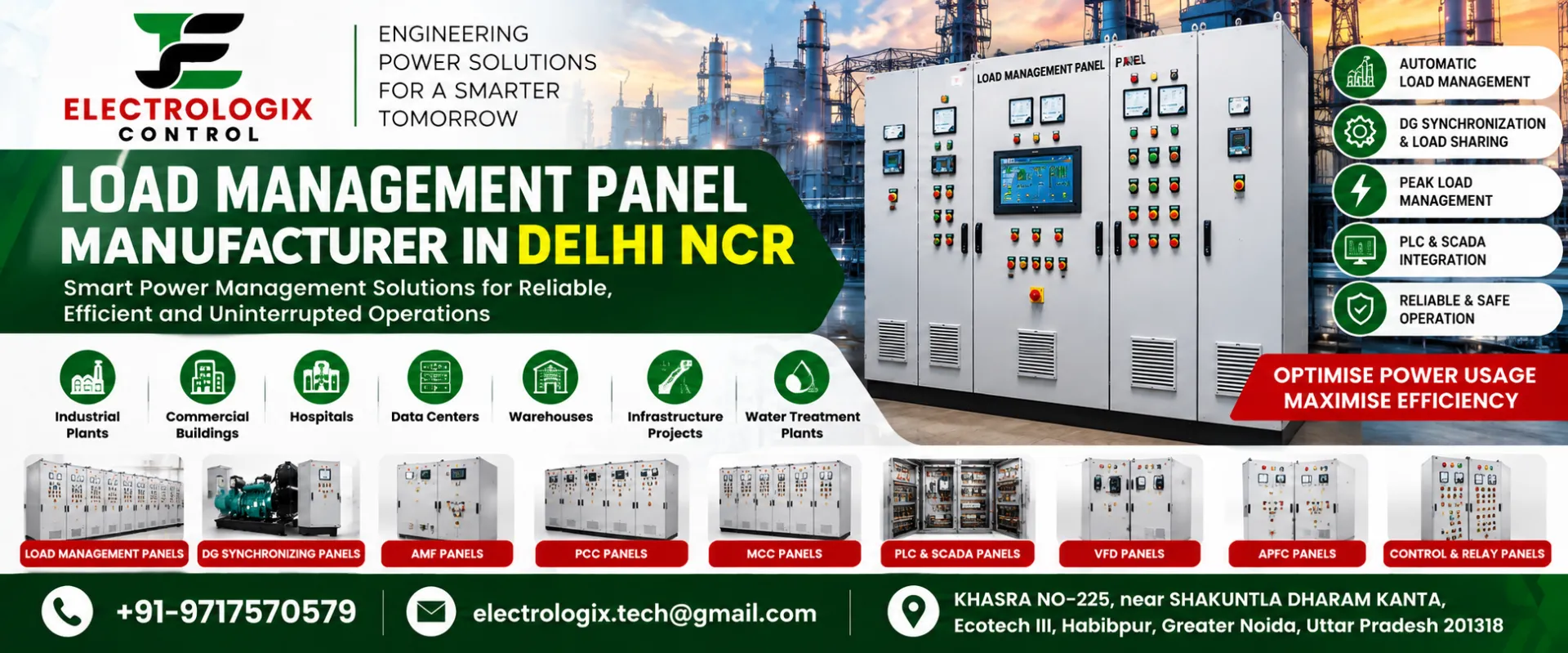
Electrologix Control System is a Load Management Panel Manufacturer in Delhi NCR, providing customized electrical control and power-management solutions for industrial plants, commercial buildings, hospitals, data centers, infrastructure projects and other facilities with complex power requirements.
A Load Management Panel is designed to monitor and control electrical loads according to available power capacity, operating conditions and the configured power-management strategy. In systems using multiple diesel generators, load management can coordinate generator operation, load sharing and generator sequencing. Depending on the application, load management can also be integrated with DG synchronization, AMF, PLC, SCADA and remote monitoring systems.
Electrologix Control System manufactures electrical panels including DG Synchronizing Panels, Automatic AMF Panels, PCC Panels, MCC Panels, PLC Control Panels, Distribution Panels and other customized electrical control solutions. The company is based in Greater Noida, Uttar Pradesh, and serves industrial and commercial requirements across Delhi NCR.
What Is a Load Management Panel?
A Load Management Panel is an electrical control system designed to manage how available electrical power is distributed among connected loads and power sources.
The objective can vary depending on the application. A load management system may be designed to:
- Monitor electrical load demand
- Prioritize critical and non-critical loads
- Coordinate multiple DG sets
- Share load between generators
- Start or stop generators according to demand
- Prevent excessive generator loading
- Support peak-load management
- Coordinate mains and DG sources
- Monitor electrical parameters
- Integrate with PLC or SCADA systems
- Provide alarms and operational status
In a multi-DG installation, load management is often closely associated with synchronization and load-sharing controls.
Electrologix’s published DG synchronization information specifically states that its panels support load sharing, load management, peak shaving and backup power applications.
Load Management Panel Manufacturer in Delhi NCR
Delhi NCR has a large concentration of manufacturing facilities, commercial complexes, hospitals, warehouses, data centers and infrastructure projects. Many of these installations have varying electrical demand and may use multiple power sources.
Electrologix Control System develops electrical control and power-management panels for such applications.
Its DG Synchronizing Panel solution is described as supporting multiple DG synchronization, load sharing, load management, peak shaving, automatic/manual synchronization and SCADA integration.
The company’s manufacturing works are located in Greater Noida, making the Delhi NCR region an important service area for its electrical panel solutions.
How Does a Load Management Panel Work?
A typical load management system can operate according to the following sequence:
Power Monitoring → Load Assessment → Power Availability Check → Load/Generator Decision → Switching or Control → Continuous Monitoring
Step 1: Monitor the Electrical System
The system receives information about electrical parameters such as load current, power, generator status and source availability.
Step 2: Determine Power Demand
The controller evaluates the current electrical demand against the available generation or supply capacity.
Step 3: Evaluate Priority
Loads can be classified according to operational importance.
For example:
- Essential loads
- Important process loads
- Non-essential loads
- Selectable loads
Step 4: Control the Power System
Based on the programmed logic, the system can coordinate generators, source selection or selected loads.
Step 5: Balance Generator Loading
Where multiple DG sets are operating in parallel, the control system can coordinate generator loading according to the configured load-sharing strategy.
Step 6: Monitor Continuously
The system continues monitoring electrical conditions and can respond to changes in demand or source availability.
The exact sequence depends on the electrical architecture, generator controllers, switchgear, PLC and load-management philosophy.
Load Management with DG Synchronization
Load management becomes particularly important when multiple DG sets operate in parallel.
For example, a facility may have three DG sets but may not require all three generators during periods of low electrical demand.
A load-management system can be configured to coordinate generator operation according to the designed control philosophy.
A simplified example is:
Low Load → One DG Operating
Medium Load → Two DGs Operating
High Load → Additional DG Capacity Available
The actual generator start/stop thresholds and operating sequence must be established according to generator capacity, minimum loading requirements, plant load profile and the generator manufacturer’s recommendations.
Electrologix states that its DG synchronizing panels support load sharing and load management for multiple-generator applications.
Load Sharing vs Load Management
These two terms are related but have different meanings.
Load Sharing
Load sharing generally refers to distributing the electrical load between generators operating in parallel.
For example, if two generators are connected to a common bus, the control system can coordinate their active and reactive power contribution according to the configured strategy.
Load Management
Load management is broader. It can include:
- Generator start/stop sequencing
- Load prioritization
- Load shedding
- Generator loading management
- Peak-load management
- Source management
- Critical-load control
A complete power-management system may use both load sharing and load management.
Load Management Panel for Multiple DG Sets
Multiple-DG installations require coordinated control of generators, breakers and electrical loads.
A load management system for multiple DGs may monitor:
- DG availability
- DG running status
- Generator capacity
- Active power
- Reactive power
- Generator current
- Generator voltage
- Frequency
- Breaker status
- Total load
- Individual feeder loads
- Alarm conditions
Based on the configured control strategy, the system can coordinate the operation of available DG sets.
This type of architecture can be useful for large industrial facilities where electrical demand changes throughout the operating day.
Automatic Load Management
An automatic load management system uses programmed control logic to respond to changes in electrical demand or power availability.
Depending on the project, automatic functions may include:
- DG start/stop
- Generator sequencing
- Load sharing
- Load shedding
- Load restoration
- Peak-load management
- Source selection
- Alarm generation
- Remote monitoring
Automation can reduce the need for continuous manual intervention, although appropriate manual and emergency operating modes should also be considered.
Load Shedding Panel
Load shedding is one possible function of a load management system.
When available power becomes insufficient for all connected loads, selected non-critical loads can be disconnected according to a predefined priority sequence.
A typical priority structure could be:
Critical Loads → Essential Loads → Important Loads → Non-Critical Loads
The exact priority sequence should be established by the facility’s electrical and operational requirements.
Load shedding can be particularly relevant where available generator capacity is limited or where maintaining critical loads is more important than supplying every connected load.
Load Management Panel with PLC
PLC-based load management provides programmable control logic for complex electrical systems.
A PLC can receive information from:
- Energy meters
- Multifunction meters
- DG controllers
- Breakers
- Protection relays
- Sensors
- Other automation systems
It can then execute the configured control sequence.
Potential PLC functions include:
- Generator sequencing
- Load prioritization
- Load shedding
- Load restoration
- Breaker control
- Alarm management
- DG status monitoring
- Communication
Electrologix’s published DG synchronization information specifically identifies PLCs and advanced controllers for automatic and manual synchronization.
Load Management Panel with SCADA
For larger facilities, a load management panel can be integrated with SCADA for centralized monitoring.
A SCADA interface can provide information such as:
- Total electrical load
- DG status
- Generator power
- Generator frequency
- Generator voltage
- Breaker status
- Load status
- Alarm status
- Trip status
- Source availability
- Operating conditions
Electrologix states that its DG synchronizing panels can integrate with SCADA and remote monitoring systems for automation and control.
Peak Load Management
Peak-load management is another application of load-management systems.
During periods of high electrical demand, the system can coordinate available generation and selected electrical loads according to the project’s control philosophy.
Potential objectives include:
- Managing peak demand
- Coordinating DG capacity
- Prioritizing critical loads
- Controlling selected non-critical loads
- Improving generator utilization
- Supporting power-management strategies
Actual results depend on the facility’s load profile, tariff structure, generator capacity and operating strategy.
Load Management Panel for Industrial Applications
Industrial facilities often have highly variable electrical loads.
A manufacturing plant may operate:
- Motors
- Pumps
- Compressors
- HVAC
- Production machinery
- Furnaces
- Conveyors
- Utility systems
- Process equipment
The electrical demand can change significantly depending on production conditions.
A load management system can be designed to monitor these changes and coordinate power sources and selected loads.
Load Management Panel for Hospitals
Hospitals have different categories of electrical loads, with certain systems requiring higher priority.
A load management system can be designed to coordinate backup generation and prioritize selected electrical circuits according to the facility’s approved electrical strategy.
Potentially important systems can include:
- Critical medical equipment
- Emergency systems
- Essential lighting
- HVAC
- Pumps
- IT systems
- Security systems
The actual priority list must be established by the facility’s electrical and safety requirements.
Load Management Panel for Data Centers
Data centers have demanding electrical requirements and may use multiple generators, UPS systems and distribution systems.
A load-management architecture can be considered for:
- Generator coordination
- Load monitoring
- Source management
- Generator loading
- Critical-load protection
- SCADA/BMS integration
Because data-center power systems are highly critical, the final design should be developed according to the site’s redundancy, protection, transfer and operational requirements.
Load Management Panel for Commercial Buildings
Large commercial facilities may have changing loads from:
- HVAC systems
- Lighting
- Elevators
- Pumps
- Fire systems
- Commercial equipment
- Building services
A load management system can coordinate selected loads and backup generation according to the facility’s operating requirements.
Main Components of a Load Management Panel
The exact components depend on the control architecture.
PLC or Load Management Controller
The controller executes the programmed load-management logic.
Energy or Multifunction Meter
Meters provide electrical measurements used by the control system.
DG Controllers
DG controllers provide generator status and operating information.
ACB/MCCB
Circuit breakers provide switching and protection for power circuits.
Protection Relays
Protection relays can monitor electrical faults and provide trip or alarm signals.
Current Transformers
CTs provide current signals for metering, monitoring and protection.
Voltage Measurement
Voltage measurement allows the controller to monitor electrical supply conditions.
HMI
An HMI can provide local visualization and operator control.
Communication Modules
Communication modules can connect the panel with PLC, SCADA, BMS or other supervisory systems.
Auxiliary Relays
Relays can provide control and signal interfaces between different electrical devices.
Customized Load Management Panel Manufacturing
Every facility has a different electrical load profile and power architecture.
Electrologix Control System can configure load-management solutions according to requirements such as:
- Number of DG sets
- DG capacity
- Connected load
- Critical-load requirement
- Load priority
- Load-shedding strategy
- Generator sequencing
- Load-sharing requirements
- Peak-load management
- AMF integration
- Breaker configuration
- PLC
- HMI
- SCADA
- Communication protocol
- Energy monitoring
- Remote monitoring
- Panel dimensions
- Installation environment
A customized approach helps align the load-management panel with the actual power system rather than relying on a generic control sequence.
Load Management Panel Selection Guide
Before ordering a load-management panel, the following information should be prepared.
1. Electrical Single-Line Diagram
The SLD helps establish the overall power distribution architecture and source connections.
2. Load Schedule
Provide connected loads, demand loads and important electrical equipment.
3. DG Details
Provide the number, capacity and controller details of available DG sets.
4. Load Priority
Identify critical, essential and non-critical loads.
5. Load-Shedding Strategy
Define which loads should be disconnected first if available power becomes insufficient.
6. Load Restoration Strategy
Define how and when disconnected loads should be restored.
7. Generator Strategy
Specify how DG sets should start, stop, synchronize and share load.
8. Monitoring Requirements
Determine which electrical parameters need to be monitored locally or remotely.
9. Communication Requirements
Specify PLC, SCADA, BMS or other communication requirements.
10. Future Expansion
Consider future generators, additional feeders and increased electrical demand during the initial design.
Load Management Panel and DG Synchronization
Load management and DG synchronization are often integrated in larger generator systems.
Electrologix’s DG synchronization product information describes:
- Multiple DG synchronization
- Load sharing
- Load management
- Peak shaving
- Automatic/manual synchronization
- Voltage, frequency and phase matching
- Protection
- PLC/controller integration
- SCADA and remote monitoring
- Grid-to-DG and DG-to-DG synchronization
This makes DG synchronization an important part of a broader generator load-management architecture.
Engineering and Quality Considerations
A load management panel requires careful engineering because it interacts with power sources, generators, breakers and electrical loads.
Important engineering considerations include:
- Accurate load measurement
- Correct CT/VT interfaces
- Generator-controller compatibility
- Breaker interlocking
- Load priority logic
- Load-shedding logic
- Load-restoration logic
- Generator sequencing
- Protection coordination
- PLC programming
- HMI configuration
- Communication
- Functional testing
- Documentation
Electrologix Control System states that its electrical panels are manufactured using optimum-grade components and checked through multiple quality stages. The company also states that it follows ISO-certified processes and has CPRI and TUV type-tested certificates for relevant products.
Why Choose Electrologix Control System?
Electrologix Control System is a Greater Noida-based manufacturer and supplier of electrical control and power-distribution panels.
Its published product range includes:
- DG Synchronizing Panels
- Automatic AMF Panels
- Distribution Panels
- PCC Panels
- MCC Panels
- PLC Control Panels
- Automatic Capacitor Panels
- Three Phase Feeder Pillars
- Other customized electrical control solutions
Its DG synchronization solution specifically addresses load management, load sharing, peak shaving and generator coordination, making it relevant for projects where generator and electrical-load management need to work together.
Load Management Panel Manufacturer Serving Delhi NCR
Electrologix Control System’s published works are located in Habibpur, Ecotech-III, Greater Noida, Uttar Pradesh.
The company can address load-management and generator-control requirements across:
- Delhi
- Noida
- Greater Noida
- Ghaziabad
- Faridabad
- Gurugram
- Manesar
- Dadri
- Jewar
- Nearby industrial areas of Uttar Pradesh and Haryana
For larger industrial projects, the load-management panel can be developed according to the site’s SLD, load schedule, DG configuration and automation requirements.
Frequently Asked Questions
What is a Load Management Panel?
A Load Management Panel is an electrical control system used to monitor and manage electrical loads and available power sources according to a programmed operating strategy.
What is the purpose of load management?
Load management can help coordinate available electrical capacity with demand through functions such as generator sequencing, load sharing, load shedding, load restoration and source management.
Can a Load Management Panel control multiple DG sets?
Yes. When appropriately engineered, it can coordinate multiple DG sets along with synchronization and load-sharing systems.
What is the difference between load sharing and load management?
Load sharing generally refers to distributing load between generators operating in parallel. Load management is broader and can include generator sequencing, load prioritization, load shedding, restoration and peak-load management.
Can load management be integrated with PLC?
Yes. PLC-based systems are commonly used where customized control logic, monitoring and communication are required.
Can a Load Management Panel be connected to SCADA?
Yes. A load-management system can be designed for SCADA integration where compatible controllers and communication interfaces are used.
Can a load management system perform load shedding?
Yes. Selected non-critical loads can be disconnected according to a predefined priority strategy when available power is insufficient.
Can a Load Management Panel be customized?
Yes. The system can be configured according to DG capacity, number of generators, load priority, switching arrangement, PLC, SCADA, metering and communication requirements.
What information is required for a load-management project?
Important information includes the electrical SLD, load schedule, DG details, generator controllers, breaker ratings, load priorities, load-shedding strategy, monitoring requirements and automation/communication requirements.
Where is Electrologix Control System located?
Electrologix Control System is based in Greater Noida, Uttar Pradesh, with its published works address in Habibpur, Ecotech-III.
Get a Customized Load Management Panel
If you are searching for a Load Management Panel Manufacturer in Delhi NCR, Electrologix Control System can evaluate your electrical distribution and generator requirements and develop an application-specific load-management solution.
For a technical enquiry, provide:
- Electrical single-line diagram
- Load schedule
- Number of DG sets
- DG kVA ratings
- Generator controller details
- Breaker details
- Critical-load information
- Load-shedding requirements
- Load-sharing requirements
- PLC/SCADA requirements
- Communication requirements
- Monitoring requirements