
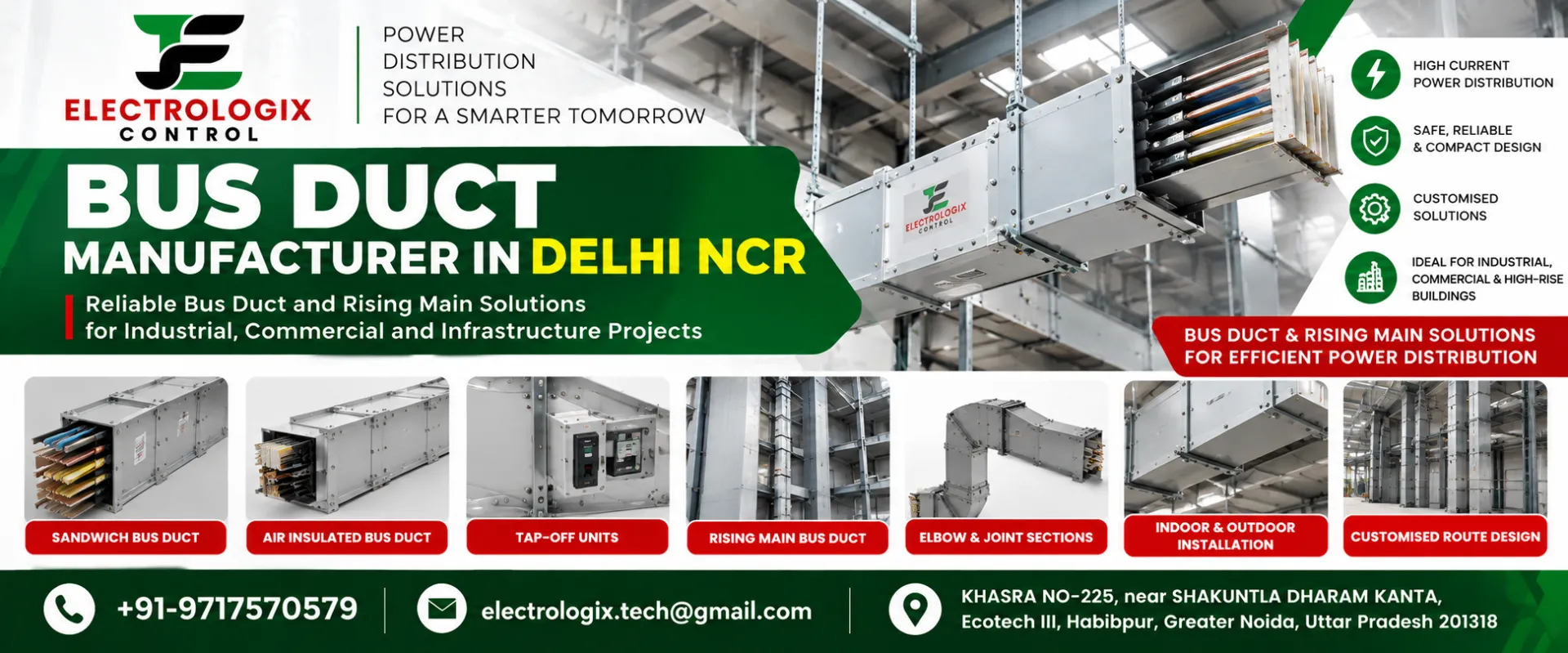
Electrologix Control System is a Bus Duct Manufacturer in Delhi NCR, providing engineered bus duct and rising main solutions for industrial plants, commercial buildings, infrastructure projects, manufacturing facilities and other high-capacity electrical distribution applications.
A bus duct, also known as a busway, is an enclosed electrical power-distribution system that uses busbars inside a protective enclosure to carry and distribute electrical power. Compared with conventional cable-based distribution, bus duct systems can provide a structured and compact method of distributing high-current electrical power between major electrical equipment and downstream loads.
Electrologix Control System includes bus ducts and rising mains in its published electrical panel portfolio, along with PCC, MCC, control and relay panels, DG synchronization panels, VFD panels and PLC/SCADA automation panels.
The company is based in Greater Noida, Uttar Pradesh, making it suitable for projects throughout the Delhi NCR industrial region.
What Is a Bus Duct?
A bus duct is an enclosed electrical distribution assembly containing conductors, typically busbars, inside a protective enclosure.
It is used to transfer and distribute electrical power between equipment such as:
- Transformers
- PCC panels
- Main LT panels
- MCC panels
- Distribution panels
- Generator systems
- Rising-main systems
- Industrial electrical loads
A bus duct can be engineered for different current capacities and installation arrangements according to the electrical system design.
A typical arrangement may be:
Transformer → Main LT/PCC Panel → Bus Duct → Distribution/MCC Panels → Electrical Loads
The actual configuration depends on the project’s load, voltage, current, short-circuit requirements, installation route and equipment arrangement.
Bus Duct Manufacturer in Delhi NCR
Large industrial and commercial facilities often require high-capacity electrical power distribution between transformers, main panels and downstream distribution systems.
Electrologix Control System provides bus duct and rising-main solutions as part of its broader electrical panel and power-distribution portfolio. Its published panel information includes bus ducts and rising mains alongside PCC and MCC systems.
Its Greater Noida manufacturing location provides access to major industrial areas across:
- Delhi
- Noida
- Greater Noida
- Ghaziabad
- Faridabad
- Gurugram
- Manesar
- Dadri
- Jewar
- Nearby industrial areas of Uttar Pradesh and Haryana
How Does a Bus Duct System Work?
The basic power-distribution arrangement can be represented as:
Transformer / Generator → Main Panel → Bus Duct → Tap-Off / Feeder → Downstream Load
Electrical power enters the bus duct from an upstream panel or transformer connection.
The busbars carry the current through the enclosed busway route. Where the design includes suitable tap-off units, power can be taken from the bus duct at designated locations and supplied to downstream panels or loads.
The system can therefore provide a defined electrical distribution path without requiring individual large power cables for every distribution point.
Bus Duct vs Cable Distribution
Both bus ducts and cables can be used for electrical power distribution. The appropriate solution depends on the project.
| Feature | Bus Duct | Cable Distribution |
|---|---|---|
| Physical arrangement | Enclosed busbar system | Individual cables |
| High-current distribution | Suitable for many applications | Also possible |
| Distribution points | Tap-off units can be provided where designed | Requires cable termination/distribution equipment |
| Installation | Structured busway route | Cable tray/trench/conduit route |
| Space requirements | Can provide compact routing in suitable installations | Can require substantial cable-management space |
| Maintenance | Accessible sections depend on design | Individual cable maintenance possible |
| Expansion | Can be convenient where designed with tap-off provisions | Additional cables may be required |
| Application | Industrial and commercial power distribution | Broad range of electrical applications |
The final choice should be based on current rating, route, environment, installation constraints, fault level, expansion requirements and project economics.
Types of Bus Duct Systems
Bus duct systems can be configured according to the electrical application.
Sandwich Bus Duct
A compact busbar arrangement in which conductors are closely arranged within the enclosure.
This type of construction can be useful where space-efficient power distribution is required.
Air Insulated Bus Duct
Air-insulated systems use air as the primary insulation medium around the conductors.
The appropriate construction depends on the electrical rating, environment and project specification.
Rising Main Bus Duct
Rising mains are vertical bus duct systems commonly used for distributing electrical power between floors of multi-storey buildings.
They can be used in:
- Commercial towers
- Residential buildings
- Hotels
- Hospitals
- Shopping complexes
- Industrial buildings
Feeder Bus Duct
A feeder bus duct is used primarily to carry power from one major electrical point to another.
Plug-In Bus Duct
Plug-in arrangements can provide designated tap-off points for downstream electrical distribution where supported by the selected busway system.
Transformer-to-Panel Bus Duct
Bus duct can be used to connect a transformer secondary directly to a main LT/PCC panel where the electrical design calls for this arrangement.
Rising Main Bus Duct Manufacturer in Delhi NCR
A rising main is a vertical electrical distribution system used primarily in multi-storey buildings.
Instead of running large numbers of individual cables vertically, a rising-main busway can distribute electrical power through a structured vertical route.
Typical applications include:
- High-rise commercial buildings
- Residential towers
- Hotels
- Hospitals
- Shopping malls
- Educational buildings
- Mixed-use developments
Tap-off arrangements can be provided at appropriate floors or distribution locations according to the system design.
Bus Duct for Industrial Power Distribution
Industrial plants often contain large electrical loads concentrated in different areas.
A bus duct system can be considered for distributing power between:
- Transformers
- PCC panels
- MCC panels
- Process panels
- Production lines
- Distribution boards
- Motor-control systems
This can provide a structured power-distribution route across the facility.
Electrologix’s published PCC information describes PCC panels as centralized systems for distributing and controlling electrical power to MCCs, machines and equipment.
Bus Duct for Transformer Connection
Transformer secondary connections can carry substantial electrical currents.
Depending on the transformer and system design, bus duct can be used between the transformer and the main LT distribution panel.
A transformer-to-panel bus duct arrangement can help create a defined high-current connection with suitable enclosure and support arrangements.
The final design should consider:
- Transformer rating
- Secondary voltage
- Full-load current
- Short-circuit level
- Connection arrangement
- Phase configuration
- Neutral requirements
- Earthing
- Installation route
- Expansion requirements
Bus Duct for PCC and MCC Systems
Bus ducts can be integrated into a broader industrial electrical distribution architecture.
A typical system may look like:
Transformer → PCC → Bus Duct → MCC / Distribution Panels → Loads
The MCC can then control motors through equipment such as:
- Contactors
- Overload relays
- VFDs
- Soft starters
- Circuit breakers
Electrologix’s published MCC information identifies MCCs as centralized motor-control assemblies incorporating circuit breakers, contactors, overload relays, VFDs and soft starters according to application.
Main Components of a Bus Duct
The exact construction depends on the bus duct design and project specification.
Conductive Busbars
The busbars carry electrical current through the busway.
Copper or aluminium may be selected according to the required electrical and mechanical characteristics.
Insulation System
The insulation system separates conductors electrically and supports safe operation according to the design.
Enclosure
The enclosure provides mechanical protection and helps protect the conductors from the surrounding environment.
Joint Assemblies
Bus duct sections require properly engineered joints to connect individual sections along the distribution route.
Tap-Off Units
Where applicable, tap-off units allow power to be taken from the bus duct and supplied to downstream equipment.
End Connections
End-feed or end-connection arrangements provide electrical connections to transformers, panels or other equipment.
Hangers and Supports
Mechanical supports maintain the bus duct route and provide appropriate structural support.
Earthing Arrangement
The bus duct system requires an appropriate earthing arrangement according to the electrical design and applicable requirements.
Customized Bus Duct Manufacturing
Bus duct requirements vary from project to project.
Electrologix Control System can evaluate project requirements involving:
- Current rating
- Voltage
- Busbar material
- Number of conductors
- Neutral arrangement
- Earth conductor
- Short-circuit withstand requirement
- Indoor/outdoor installation
- Horizontal routing
- Vertical routing
- Transformer connection
- PCC connection
- MCC connection
- Tap-off requirements
- Installation dimensions
- Route length
- Expansion requirements
A customized approach allows the bus duct system to be coordinated with the main electrical panels and overall distribution architecture.
Bus Duct Selection Guide
Before selecting a bus duct manufacturer, the following information should be established.
1. Electrical Current
Determine the required continuous current rating based on the electrical load.
2. System Voltage
Specify the operating voltage and phase configuration.
3. Short-Circuit Level
The available fault current should be considered when determining the required bus duct withstand capability.
4. Busbar Material
Copper or aluminium conductors may be considered according to electrical, mechanical and project requirements.
5. Neutral Requirement
Determine whether a full-size or reduced neutral arrangement is appropriate for the system.
6. Earthing
Define the required protective-earth arrangement.
7. Installation Route
Provide drawings or route information for horizontal, vertical or combined installation.
8. Tap-Off Requirements
Determine where downstream loads or panels need to receive power from the bus duct.
9. Environmental Conditions
Temperature, dust, moisture, corrosive conditions and indoor/outdoor installation should be evaluated.
10. Future Expansion
Where additional loads are expected, expansion provisions should be considered during initial design.
Bus Duct for High-Current Applications
Bus duct systems are often considered where electrical power needs to be distributed at relatively high current levels.
Applications can include:
- Manufacturing plants
- Large commercial buildings
- Data facilities
- Industrial utilities
- Power-intensive machinery
- Transformer connections
- Generator distribution
- Multi-storey building distribution
The appropriate current rating should always be established from the actual load schedule and electrical design.
Bus Duct and Electrical Safety
Safety considerations are important when designing and installing a bus duct system.
Important considerations include:
- Appropriate insulation
- Enclosure integrity
- Earthing
- Correct joint installation
- Proper mechanical support
- Protection coordination
- Suitable clearances
- Correct tap-off installation
- Short-circuit withstand capability
- Proper termination
- Inspection and testing
The system should be designed and installed according to the applicable project standards and electrical requirements.
Bus Duct Engineering and Quality
A bus duct system is an engineered electrical assembly, and its performance depends on conductor selection, insulation, enclosure construction, joints, supports, connections and testing.
Electrologix Control System states that its electrical products are manufactured using optimum-grade components and checked through multiple quality stages before supply. The company also states that it follows ISO-certified processes and has CPRI and TUV type-tested certificates for relevant products.
Its published draw-out panel information specifically lists bus ducts and rising mains and describes modular construction, busbar design and other panel-engineering features.
For a bus duct project, engineering documentation may include:
- Single-line diagram
- General arrangement drawing
- Bus duct route drawing
- Current rating
- Voltage rating
- Short-circuit rating
- Joint details
- Tap-off details
- Connection details
- Earthing arrangement
- Installation requirements
- Test documentation
Bus Duct Manufacturer for Commercial Buildings
Commercial buildings can use bus duct and rising-main systems for vertical and horizontal electrical distribution.
Typical applications include:
- High-rise offices
- Hotels
- Hospitals
- Shopping malls
- Residential towers
- Educational buildings
- Mixed-use buildings
For high-rise applications, rising mains can distribute electrical power vertically, with tap-off points supplying individual floors or distribution sections where required.
Bus Duct Manufacturer for Industrial Plants
Industrial plants can use bus duct systems to distribute electrical power between transformers, main LT panels, MCCs and production areas.
Potential applications include:
- Automobile plants
- Engineering factories
- Process industries
- Warehouses
- Manufacturing facilities
- Food-processing plants
- Pharmaceutical facilities
- Water-treatment plants
The bus duct route should be coordinated with building structure, equipment locations, cable routes and maintenance access.
Why Choose Electrologix Control System?
Electrologix Control System is a Greater Noida-based electrical panel manufacturer and supplier. Its published product information includes bus ducts and rising mains within its draw-out/panel portfolio.
Its wider electrical product range includes:
- PCC Panels
- MCC Panels
- Distribution Panels
- PLC Control Panels
- VFD Panels
- DG Synchronizing Panels
- AMF Panels
- Control and Relay Panels
- Bus Ducts
- Rising Mains
This broader product capability can be useful when bus duct requirements need to be coordinated with PCC, MCC, distribution and automation systems.
The company states that it has been operating from Greater Noida since 2020 and manufactures electrical products using optimum-grade components with quality checks at multiple stages.
Bus Duct Manufacturer Serving Delhi NCR
Electrologix Control System’s published works address is:
Khasra No-225, Village Habibpur, Ecotech-III, near Shakuntla Dharam Kanta, Greater Noida, Uttar Pradesh – 201306.
The company serves electrical panel and bus duct requirements across the wider Delhi NCR region, including:
- Delhi
- Noida
- Greater Noida
- Ghaziabad
- Faridabad
- Gurugram
- Manesar
- Dadri
- Jewar
- Nearby industrial areas of Uttar Pradesh and Haryana
Frequently Asked Questions
What is a bus duct?
A bus duct is an enclosed electrical distribution system containing busbars for carrying and distributing electrical power between major electrical equipment and downstream loads.
What is the difference between bus duct and cable?
A bus duct uses enclosed busbars, while cable systems use insulated electrical cables. The appropriate choice depends on current rating, route, space, installation environment, expansion requirements and project design.
What is a rising main?
A rising main is a vertical busway system used to distribute electrical power through multiple floors of a building.
Where are bus ducts commonly used?
Bus ducts are used in industrial plants, commercial buildings, high-rise structures, transformer connections, PCC/MCC systems, generator systems and other high-capacity electrical distribution applications.
Can bus ducts be customized?
Yes. Bus duct systems can be designed according to current rating, voltage, conductor material, route, tap-off requirements, short-circuit level, installation environment and project specifications.
Can a bus duct connect a transformer to a PCC?
Yes. Transformer-to-PCC bus duct connections can be used where the electrical design calls for a high-current enclosed connection.
Can bus ducts be used with MCC panels?
Yes. Bus ducts can form part of the electrical distribution arrangement supplying MCCs and other downstream electrical panels.
What information is required for bus duct manufacturing?
Important information includes system voltage, current rating, short-circuit level, conductor material, neutral and earth requirements, route dimensions, tap-off requirements, connection details and installation environment.
Does Electrologix manufacture rising mains?
Electrologix’s published panel portfolio specifically lists bus ducts and rising mains.
Where is Electrologix Control System located?
Electrologix Control System is based in Ecotech-III, Greater Noida, Uttar Pradesh. Its published works address is in Village Habibpur, Greater Noida.
Get a Customized Bus Duct Solution
If you are searching for a Bus Duct Manufacturer in Delhi NCR, Electrologix Control System can discuss your electrical distribution requirements and develop a suitable bus duct or rising-main configuration.
For a technical enquiry, provide:
- System voltage
- Current rating
- Transformer details
- PCC/MCC details
- Bus duct route
- Horizontal/vertical installation
- Busbar material
- Short-circuit requirements
- Neutral and earth requirements
- Tap-off requirements
- Installation environment
- Future expansion requirements