
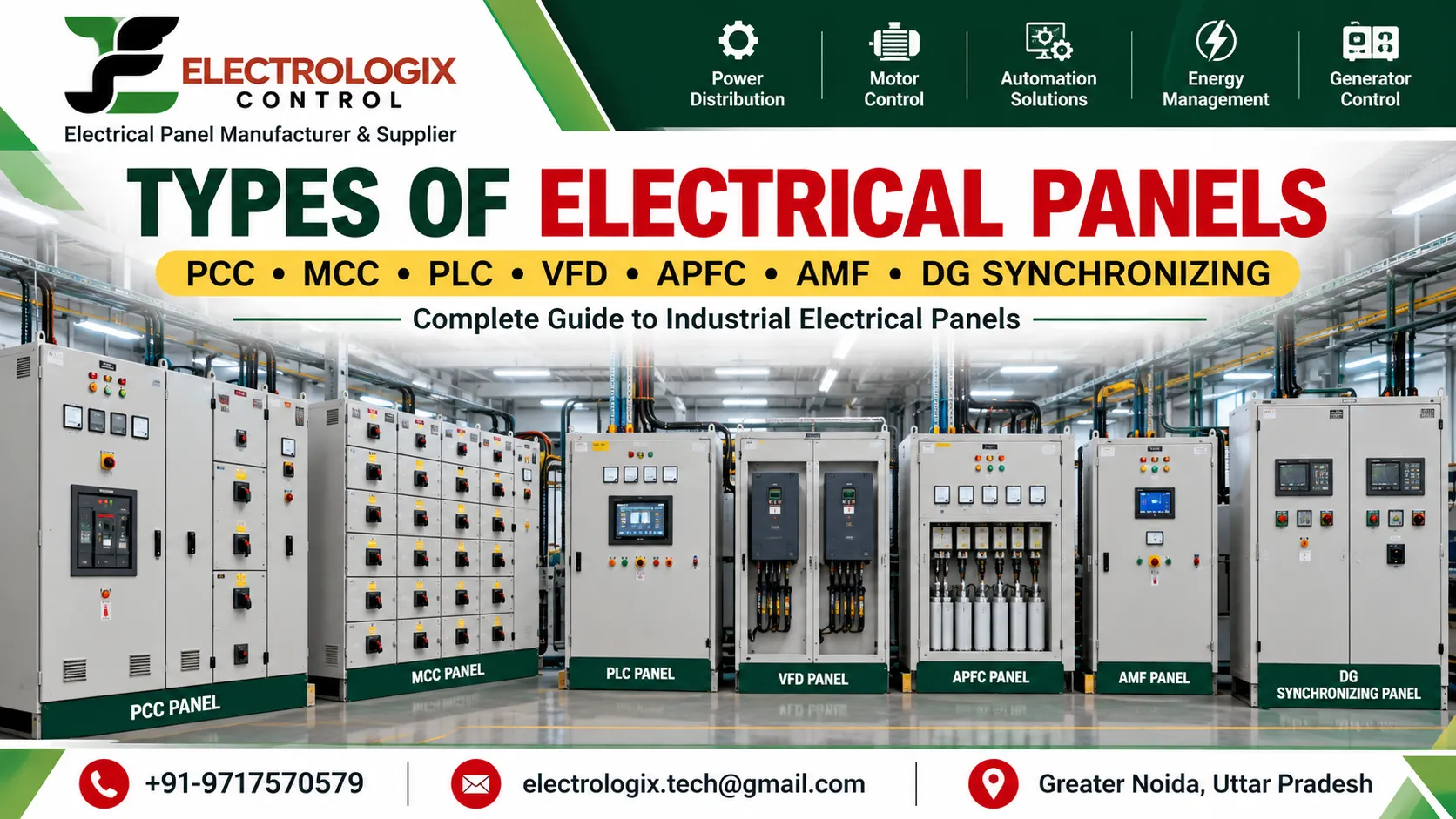
Electrical panels are an important part of modern power distribution, motor control and industrial automation systems. From distributing incoming electrical power to controlling motors, managing generator operations and automating industrial processes, different types of electrical panels are designed for different functions.
Choosing the appropriate panel depends on several factors, including the electrical load, voltage level, short-circuit requirements, motor applications, automation requirements, environmental conditions, available space and future expansion plans.
For industries in Delhi NCR, Noida, Greater Noida, Ghaziabad, Faridabad, Gurugram and nearby industrial areas, understanding the difference between various electrical panel types can make electrical system planning easier.
This guide explains the major types of electrical panels, their functions, applications, important components and factors to consider before selecting a panel.
What Is an Electrical Panel?
An electrical panel is an engineered enclosure that contains electrical switching, protection, control, measurement and, where required, automation components.
Depending on its application, a panel may include circuit breakers, contactors, relays, busbars, meters, protection devices, PLCs, HMIs, VFDs, control transformers, terminal blocks and communication equipment.
In industrial applications, control panels can bring electrical and automation components together to monitor, control and protect machinery and processes.
The panel is designed according to the electrical and operational requirements of a particular installation rather than using one standard configuration for every application.
Why Are Electrical Panels Important?
Electrical panels perform several important functions in an electrical installation:
- Power distribution
- Circuit protection
- Motor control
- Equipment switching
- Process automation
- Generator control
- Power factor management
- Electrical measurement
- Fault isolation
- System monitoring
- Communication with automation systems
A properly engineered panel can help organize electrical equipment, simplify operation and maintenance, and provide appropriate protection for connected equipment.
Major Types of Electrical Panels
There are many panel configurations used in commercial, industrial and infrastructure projects. Some of the commonly used industrial electrical panels include:
- Power Control Center (PCC) Panel
- Motor Control Center (MCC) Panel
- PLC Control Panel
- Variable Frequency Drive (VFD) Panel
- Automatic Power Factor Correction (APFC) Panel
- Automatic Mains Failure (AMF) Panel
- DG Synchronizing Panel
- Control and Relay Panel
- Distribution Panel
- Feeder Pillar Panel
- Auto Changeover Panel
- Outdoor Electrical Panel
- Draw-Out Panel
Each type has a different purpose and may be used independently or integrated into a larger electrical and automation system.
1. Power Control Center (PCC) Panel
A Power Control Center, commonly called a PCC panel, is primarily used for power distribution and control within an electrical installation.
PCC panels can receive power from an incoming source and distribute it to multiple outgoing feeders supplying different loads.
Typical PCC applications include:
- Industrial plants
- Manufacturing facilities
- Commercial buildings
- Infrastructure projects
- Warehouses
- Utility installations
- Process industries
Depending on the project, PCC panels may incorporate incoming and outgoing circuit breakers, busbars, metering, protection devices and feeder arrangements.
The actual configuration, current rating, fault withstand capability and protection scheme should be determined from the project electrical design.
2. Motor Control Center (MCC) Panel
MCC stands for Motor Control Center.
An MCC panel is designed to control and protect multiple motors from a centralized location. MCCs commonly group motor control units around a common power bus and may include starters, circuit breakers, contactors, overload protection, VFDs and other control equipment.
MCC panels are commonly used in:
- Manufacturing plants
- Water treatment plants
- HVAC systems
- Process industries
- Pharmaceutical plants
- Food processing facilities
- Infrastructure projects
- Industrial production lines
Fixed MCC vs Draw-Out MCC
Fixed MCC panels have permanently installed functional units, while draw-out configurations allow certain functional units to be withdrawn for maintenance or replacement.
The appropriate arrangement depends on operational requirements, maintenance strategy, available space and project specifications.
3. PLC Control Panel
PLC stands for Programmable Logic Controller.
A PLC control panel is used when automated control and sequential operation of industrial equipment or processes are required.
A typical PLC system may include:
- PLC CPU
- Digital input modules
- Digital output modules
- Analog input modules
- Analog output modules
- Power supply
- Communication modules
- Relays
- Terminal blocks
- Circuit protection
- HMI interface
PLC systems receive signals from field devices, process programmed logic and send control signals to connected equipment. Modern PLC systems can also communicate with HMIs, drives, SCADA systems and industrial networks.
PLC panels are widely used for machine automation, process control, material handling, pumping systems and other industrial applications.
4. Variable Frequency Drive (VFD) Panel
A Variable Frequency Drive panel, commonly called a VFD panel, is used to control the speed and operating characteristics of compatible AC motors.
A VFD can adjust motor operating speed according to application requirements, making it useful for applications where variable-speed motor control is required.
Common applications include:
- Pumps
- Fans
- Blowers
- Conveyors
- HVAC systems
- Compressors
- Industrial machinery
A VFD panel may include the drive, incoming protection, bypass arrangement where specified, contactors, control terminals, ventilation or cooling provisions and monitoring components.
VFD selection should consider motor rating, voltage, current, duty cycle, starting requirements, environmental conditions, harmonics and control philosophy.
5. APFC Panel
APFC stands for Automatic Power Factor Correction.
An APFC panel automatically switches capacitor steps according to the electrical system’s reactive power requirement.
The main purpose of an APFC system is to maintain the power factor within the desired operating range under changing loads.
An APFC panel can include:
- APFC relay/controller
- Capacitor banks
- Capacitor-duty contactors or switching devices
- HRC fuses or protective devices
- Busbars
- Detuned reactors where required
- Indication and metering
APFC systems are particularly relevant to industrial facilities with significant inductive loads such as motors and transformers.
The capacitor and reactor selection should be based on actual load characteristics and harmonic conditions rather than using a generic configuration.
6. AMF Panel
AMF stands for Automatic Mains Failure.
An AMF panel is used in generator-based backup power systems to monitor the mains supply and control generator start/stop and changeover functions according to the configured control logic.
A typical AMF system may perform functions such as:
- Monitoring mains availability
- Sending generator start command
- Monitoring generator parameters
- Transferring load according to the configured scheme
- Returning the load to mains when conditions are restored
- Sending generator stop command after the required delay
AMF panels are commonly used where automatic backup power operation is required.
The exact sequence depends on the generator controller, changeover equipment and project requirements.
7. DG Synchronizing Panel
A DG Synchronizing Panel is used when multiple diesel generator sets need to operate in synchronization with each other and, depending on the system design, with a common bus or other power sources.
Synchronization involves matching relevant electrical parameters before connecting sources together.
A DG synchronization system may manage:
- Generator voltage
- Frequency
- Phase relationship
- Load sharing
- Generator start/stop logic
- Breaker control
- Protection
- System monitoring
Such systems are used in facilities where multiple generator sets are required to supply a common load.
The synchronization philosophy should be developed according to generator specifications, load profile, protection requirements and the overall electrical system design.
8. Control and Relay Panel
Control and relay panels are designed for monitoring, control, protection and switching functions in electrical systems.
Depending on the application, these panels can include:
- Protection relays
- Control relays
- Auxiliary relays
- Timers
- Meters
- Indicating lamps
- Selector switches
- Push buttons
- Terminal blocks
- Communication devices
They can be used in electrical distribution systems, generator systems, substations and industrial control applications.
The relay and control scheme should be designed according to the equipment being protected and the required operating sequence.
9. Electrical Distribution Panel
A distribution panel distributes electrical power to multiple downstream circuits while providing appropriate circuit protection.
Depending on the installation, distribution panels can contain different types of circuit breakers, busbars, metering and protective equipment.
They are used in:
- Industrial buildings
- Commercial facilities
- Manufacturing plants
- Warehouses
- Infrastructure projects
The panel rating and outgoing feeder arrangement should be selected according to the connected loads and electrical design.
10. Feeder Pillar Panel
A feeder pillar is generally an outdoor electrical distribution enclosure used for controlling and distributing power to multiple outgoing circuits.
Feeder pillars are commonly used for:
- Outdoor distribution
- Street lighting
- Infrastructure projects
- Industrial campuses
- Utility applications
- External electrical networks
Outdoor feeder pillars require appropriate enclosure construction and environmental protection based on their installation conditions.
11. Auto Changeover Panel
An auto changeover panel is designed to transfer a load between two available power sources according to a defined control sequence.
Common source combinations include:
- Main supply and DG
- Two utility sources
- Main supply and alternate supply
The panel can incorporate electrically and mechanically interlocked switching arrangements, control logic, timers, indicators and protection devices.
The changeover sequence must be designed according to the characteristics of the connected sources and the criticality of the load.
12. Outdoor Electrical Panel
Outdoor electrical panels are designed for installation in exposed or semi-exposed environments.
Compared with indoor installations, outdoor panels may require additional consideration for:
- Rain
- Dust
- Temperature
- Humidity
- Solar exposure
- Corrosion
- Ingress protection
- Ventilation
- Cable entry
The enclosure and components should therefore be selected according to the actual site environment and applicable project specifications.
13. Draw-Out Panel
A draw-out panel uses withdrawable functional units or components to support maintenance and operational flexibility.
Draw-out arrangements can be used in different panel applications, including PCC, MCC and other engineered LV switchboard configurations.
One of the practical benefits of withdrawable construction is easier access to individual functional units compared with permanently fixed arrangements. The exact maintenance and isolation procedure depends on the panel design and safety system.
Electrical Panel Components
The components used in an electrical panel depend on its function.
Common components include:
Circuit Breakers
Circuit breakers provide switching and protection against defined electrical fault conditions.
Busbars
Busbars provide a common electrical distribution path within the panel.
Contactors
Contactors are electrically controlled switching devices commonly used for motor and other load control.
Relays
Relays are used for control logic, interlocking, signalling and protection functions depending on the relay type.
Protection Relays
Protection relays monitor electrical parameters and initiate defined protective actions when abnormal conditions are detected.
PLC
A PLC executes programmed control logic for automated industrial processes.
HMI
An HMI provides an operator interface for monitoring and controlling connected equipment.
VFD
A VFD controls motor operation where variable-speed control is required.
Energy Meters
Meters can provide measurements such as voltage, current, power, energy and power factor, depending on the device.
Terminal Blocks
Terminal blocks provide organized termination and interconnection between internal panel wiring and field cables.
How to Choose the Right Electrical Panel?
Selecting an electrical panel should start with the application rather than the panel name.
Consider the following factors:
1. Connected Load
Calculate the total connected and demand load before selecting the panel rating.
2. Voltage and Current
The panel must be suitable for the system voltage and expected current.
3. Short-Circuit Level
The prospective fault level is important when selecting suitable switchgear and panel construction.
4. Number of Feeders
The number and type of incoming and outgoing feeders influence panel dimensions and internal configuration.
5. Motor Requirements
For motor applications, consider starting current, motor rating, starting method, speed control and operating duty.
6. Automation Requirements
Determine whether the system requires PLC, HMI, SCADA, communication or remote monitoring.
7. Installation Environment
Indoor and outdoor installations have different enclosure and environmental requirements.
8. Maintenance Requirements
If quick access or replacement of functional units is important, a draw-out configuration may be considered.
9. Future Expansion
Space and electrical capacity for future feeders or equipment should be considered during initial engineering wherever practical.
10. Applicable Standards and Project Specifications
The panel design should follow the applicable standards, project specifications and required testing or certification requirements.
Difference Between PCC, MCC, PLC and VFD Panels
| Panel Type | Main Function | Typical Application |
|---|---|---|
| PCC | Power distribution and control | Industrial power distribution |
| MCC | Motor control and protection | Multiple motor applications |
| PLC Panel | Automated process control | Industrial automation |
| VFD Panel | Variable-speed motor control | Pumps, fans, conveyors |
| APFC Panel | Power factor correction | Industrial electrical systems |
| AMF Panel | Automatic mains/generator operation | Backup power systems |
| DG Synchronizing Panel | Generator synchronization | Multiple DG systems |
| Control & Relay Panel | Control and protection | Electrical control systems |
| Feeder Pillar | Outdoor distribution | Infrastructure and outdoor systems |
These panels are not interchangeable. A project may require one panel type or several panels working together as part of a coordinated electrical system.
Applications of Industrial Electrical Panels
Industrial electrical panels are used across a wide range of sectors, including:
- Manufacturing
- Automotive
- Pharmaceuticals
- Food processing
- Water and wastewater
- HVAC
- Commercial buildings
- Warehouses
- Infrastructure
- Data and utility facilities
- Process industries
- Renewable energy installations
The exact panel configuration varies according to the electrical load, process requirements, operating environment and automation architecture.
Electrical Panel Manufacturing in Delhi NCR
Delhi NCR has a large concentration of manufacturing facilities, commercial developments, warehouses, infrastructure projects and industrial plants.
Industrial electrical projects in Delhi, Noida, Greater Noida, Ghaziabad, Faridabad and Gurugram can require different combinations of power distribution, motor control and automation panels.
Electrologix Control System is based in Greater Noida, Uttar Pradesh, and manufactures and supplies electrical panels including distribution panels, PLC control panels, automatic MCC panels, automatic AMF panels, three-phase feeder pillars, DG synchronization panels, automatic capacitor panels and automatic PCC panels. The company states that its products are checked through multiple quality stages and also provides electrical transformer installation services.
Why Panel Engineering Matters
An electrical panel is more than a metal enclosure containing electrical components.
The panel’s performance depends on correct engineering of:
- Electrical ratings
- Busbar arrangement
- Protection coordination
- Component selection
- Heat dissipation
- Cable termination
- Control wiring
- Interlocking
- Earthing
- Enclosure construction
- Accessibility
- Testing
A panel that is appropriately designed for its intended application can make installation, operation and maintenance more organized.
Frequently Asked Questions
What are the main types of electrical panels?
Common industrial electrical panels include PCC, MCC, PLC, VFD, APFC, AMF, DG synchronizing, control and relay, distribution, feeder pillar and draw-out panels.
What is the difference between PCC and MCC panels?
A PCC panel primarily focuses on power distribution, while an MCC panel is designed mainly for centralized control and protection of multiple motors.
What is an MCC panel used for?
An MCC panel is used to control and protect multiple motors from a centralized electrical assembly. It can include motor starters, protection devices, contactors, VFDs and monitoring equipment.
What is a PLC panel?
A PLC panel houses a programmable logic controller and associated electrical and automation components used to control industrial machinery or processes.
What is a VFD panel used for?
A VFD panel is used for applications requiring variable-speed control of compatible AC motors, such as pumps, fans, blowers and conveyors.
What is an APFC panel?
An APFC panel automatically switches capacitor stages to manage reactive power and maintain the desired power factor under changing electrical loads.
What is an AMF panel?
An AMF panel controls automatic generator operation and source changeover according to a predefined sequence when the mains supply fails or returns.
What is a DG synchronizing panel?
A DG synchronizing panel coordinates multiple generator sets so they can operate together on a common electrical system according to the configured synchronization and load-sharing scheme.
What should I consider before ordering an electrical panel?
Important considerations include system voltage, current, connected load, fault level, number of feeders, motor requirements, automation requirements, installation environment, enclosure requirements, future expansion and applicable standards.
Conclusion
Different electrical panels serve different electrical and automation requirements. PCC panels are primarily associated with power distribution, MCC panels with motor control, PLC panels with automation, VFD panels with variable-speed motor control, APFC panels with power factor management, and AMF or DG synchronizing panels with generator-based power systems.
Selecting the right panel requires an understanding of the complete electrical system rather than simply choosing a panel based on its name.
For industrial projects, proper electrical engineering, component selection, protection design, panel construction and testing are important parts of developing an appropriate panel solution.
Electrologix Control System provides electrical panel manufacturing and related industrial electrical solutions from Greater Noida for applications across Delhi NCR and other project locations, subject to project requirements.