
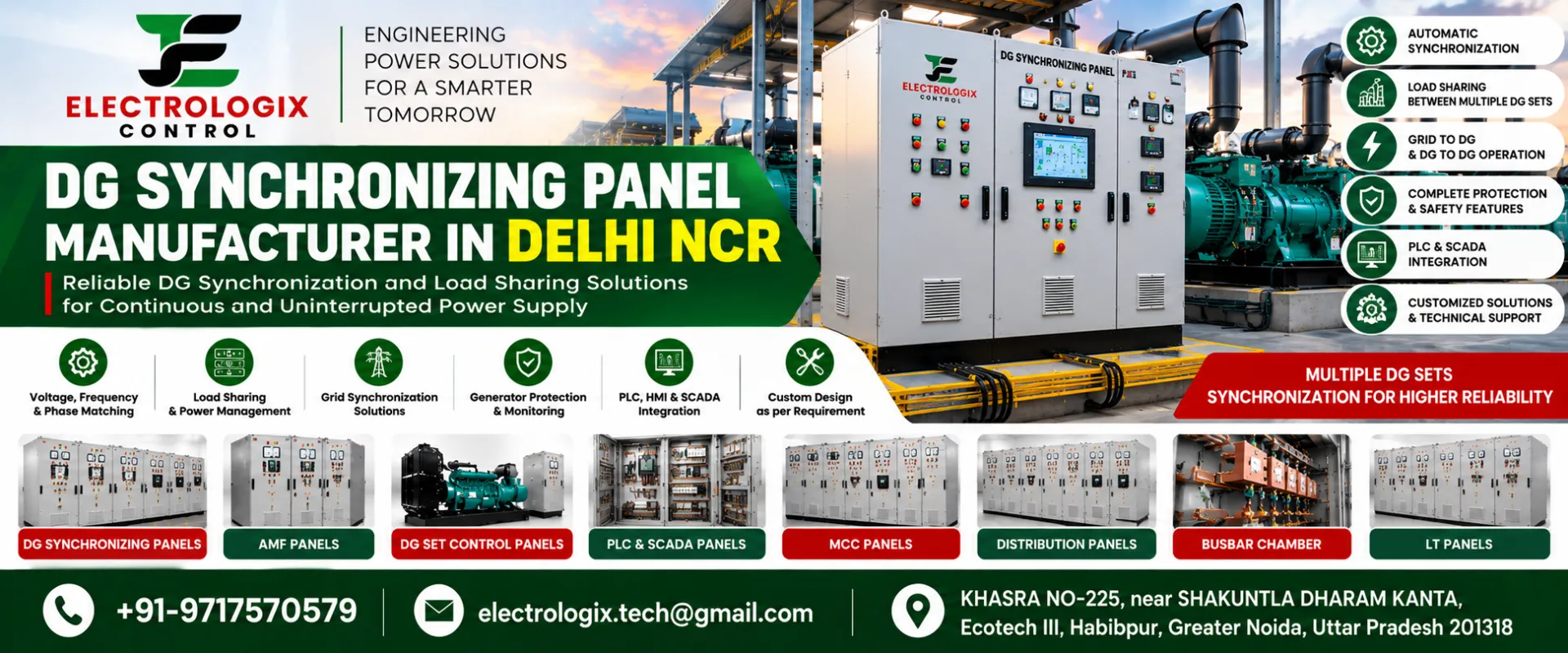
Electrologix Control System is a DG Synchronizing Panel Manufacturer in Delhi NCR, providing engineered synchronization and generator control panels for industrial, commercial, infrastructure, institutional and critical power applications.
A DG Synchronizing Panel is used when two or more diesel generator sets need to operate together in parallel with coordinated control of voltage, frequency, phase sequence, load sharing and generator connection. A properly designed synchronization system can help multiple DG sets work as a coordinated power source according to the electrical load and operating requirements.
Electrologix Control System manufactures DG Synchronizing Panels along with AMF Panels, PCC Panels, MCC Panels, PLC Control Panels, Distribution Panels, Automatic Capacitor Panels and other electrical control systems. The company is based in Greater Noida, Uttar Pradesh, serving projects across Delhi NCR and other industrial locations.
What Is a DG Synchronizing Panel?
A DG Synchronizing Panel is an electrical control and switching panel designed to synchronize multiple diesel generator sets before connecting them to a common busbar or electrical load.
For generators to operate in parallel, important electrical parameters must be appropriately matched. These can include:
- Voltage
- Frequency
- Phase sequence
- Phase angle
- Generator availability
- Load demand
- Breaker status
Once the required synchronization conditions are satisfied, the appropriate generator breaker can be closed according to the system control logic.
The panel can also incorporate load-sharing, generator protection, monitoring, automatic start/stop and communication functions depending on the project requirements.
DG Synchronizing Panel Manufacturer in Delhi NCR
Electrologix Control System’s published product information specifically includes DG Synchronizing Panels. Its product description states that the panels are designed for synchronization of multiple DG sets and can support automatic or manual synchronization, load sharing, PLC/controller integration, SCADA and protection functions.
The company is located in Greater Noida, Uttar Pradesh, within the Delhi NCR industrial region. Electrologix Control System
Its broader published product range includes Automatic AMF Panels, PCC Panels, MCC Panels, PLC Control Panels, Distribution Panels and Automatic Capacitor Panels.
This combination allows DG synchronization to be considered as part of a wider electrical distribution and automation architecture.
Why Is DG Synchronization Required?
A single DG set may not always be sufficient for a large electrical load. In such cases, multiple generators can be operated in parallel.
DG synchronization can be considered when a facility requires:
- Higher available generation capacity
- Multiple generator operation
- Load sharing between DG sets
- Generator redundancy
- Automatic generator sequencing
- Flexible generator operation
- Improved utilization of installed generation capacity
- Integration with a centralized power-management system
For example, a facility with several DG sets may operate fewer generators during lower load conditions and bring additional generators online when demand increases, subject to the designed control philosophy.
How Does a DG Synchronizing Panel Work?
The basic synchronization sequence can be represented as:
DG Start → Voltage/Frequency Stabilization → Parameter Measurement → Synchronization Check → Breaker Closing → Load Sharing → Continuous Monitoring
Step 1: DG Start
The control system starts the required generator based on the operating sequence.
Step 2: Generator Stabilization
The generator reaches its operating voltage and frequency.
Step 3: Electrical Parameter Measurement
The synchronizing system monitors the required generator and bus parameters.
Step 4: Synchronization Check
The controller evaluates the required synchronization conditions, including voltage, frequency and phase relationship.
Step 5: Generator Breaker Closing
When the configured synchronization conditions are satisfied, the generator breaker can be closed onto the common bus.
Step 6: Load Sharing
Once connected, the control system can coordinate generator loading according to the configured load-sharing strategy.
Step 7: Continuous Monitoring
Generator and bus conditions continue to be monitored for abnormal conditions and protection requirements.
The exact synchronization method and control sequence depend on the generator controllers, synchronizer, switchgear and project design.
Automatic DG Synchronization
Automatic synchronization reduces the need for manual matching of generator electrical parameters.
An automatic synchronizing controller can monitor generator and bus conditions and issue the breaker-closing command when the configured synchronization criteria are satisfied.
This can be useful for facilities where:
- Multiple DGs are operated routinely
- Generator operation needs to be coordinated
- Load demand changes throughout the day
- Manual synchronization would be impractical
- Centralized generator monitoring is required
Automatic synchronization should be engineered together with the DG governor, AVR, generator controller and breaker system.
Manual DG Synchronization
Some installations may require a manual synchronization mode for testing, commissioning, maintenance or operational flexibility.
Depending on the panel design, the operator may be provided with suitable controls and indications to observe generator and bus conditions.
Manual operation should always be carried out according to the approved electrical operating procedure and protection philosophy.
DG Synchronizing Panel with Load Sharing
Load sharing is an important function in a multi-generator installation.
When multiple DG sets operate in parallel, the control system can coordinate generator loading so that the generators operate according to the configured load-sharing strategy.
Load sharing may involve coordination of:
- Active power
- Reactive power
- Generator capacity
- Load demand
- Generator priority
- Generator availability
The actual load-sharing method depends on the generator controllers and system architecture.
DG Synchronization with AMF
DG synchronization and AMF functions can work together in installations requiring automatic generator operation.
An AMF system can detect mains failure and initiate the generator start sequence. When multiple DGs are available, the synchronization system can coordinate the generators before connecting them to the common bus.
A simplified sequence can be:
Mains Failure → DG Start Command → DGs Available → Synchronization → Common Bus Connection → Load Sharing
When mains supply is restored, the system can follow the configured shutdown and transfer sequence.
Electrologix also manufactures Automatic AMF Panels, making it possible to consider AMF and DG synchronization requirements together for suitable projects.
DG Synchronizing Panel Components
The components vary according to generator capacity, number of DG sets and project requirements.
Synchronizing Controller
The synchronizing controller manages synchronization logic and evaluates generator and bus electrical parameters.
Generator Controllers
Generator controllers provide information and control interfaces for the individual DG sets.
ACB or MCCB
Circuit breakers provide generator-to-bus switching and electrical protection according to the system design.
Synchronizing Relay or Synchronizer
The synchronization device evaluates the required electrical parameters before permitting breaker closing.
Current Transformers
CTs can provide current measurement signals for protection, metering and load-sharing functions.
Voltage Sensing
Voltage measurement is required to compare generator and bus conditions.
Frequency Measurement
Frequency information is used to evaluate generator operating conditions before synchronization.
Protection Relays
Protection devices can be incorporated according to the generator and system protection requirements.
Auxiliary Relays
Auxiliary relays provide signal interfacing between controllers, breakers, protection systems and external equipment.
Metering
Meters can display or communicate parameters such as:
- Voltage
- Current
- Frequency
- Power
- Power factor
- Energy
- Generator operating status
HMI
An HMI can provide a centralized operator interface for monitoring and control where required.
DG Synchronizing Panel Protection Features
Protection is a critical part of a generator paralleling system.
Depending on the electrical design, protection functions may include:
- Overcurrent protection
- Short-circuit protection
- Earth-fault protection
- Overvoltage protection
- Undervoltage protection
- Overfrequency protection
- Underfrequency protection
- Reverse power protection
- Phase failure protection
- Phase sequence protection
- Generator fault monitoring
- Breaker trip monitoring
- Emergency shutdown
Not every installation requires the same protection functions. The protection scheme should be established from the generator specifications, system fault levels, switchgear ratings and coordination study where applicable.
DG Synchronizing Panel with PLC and SCADA
Industrial installations may require synchronization and generator information to be available through a centralized automation system.
A DG synchronization system can be designed for integration with:
- PLC
- SCADA
- HMI
- BMS
- Energy Management Systems
- Remote monitoring systems
Depending on the selected controllers and communication architecture, information can include:
- DG running status
- Generator voltage
- Generator current
- Frequency
- Active power
- Reactive power
- Power factor
- Breaker status
- Alarm status
- Trip status
- Generator availability
- Operating hours
Electrologix’s published panel range includes PLC/SCADA automation panels and intelligent/smart panel solutions for industrial applications.
Types of DG Synchronizing Panels
Two DG Synchronizing Panel
Designed for installations where two generator sets need to operate in parallel.
Multiple DG Synchronizing Panel
Used for systems involving several generators operating according to a defined synchronization and load-management strategy.
Auto Synchronizing Panel
Provides automatic synchronization based on configured electrical conditions and controller logic.
Manual and Auto Synchronizing Panel
Provides selectable operating modes for automatic and manual operation where required.
AMF and Synchronizing Panel
Combines mains-failure control with multi-generator synchronization functions in appropriate system architectures.
DG Synchronizing and Load Sharing Panel
Designed for systems where multiple DG sets need coordinated load sharing.
DG Synchronizing Panel with SCADA
Provides synchronization and generator information to a supervisory monitoring system where communication is required.
Applications of DG Synchronizing Panels
DG synchronization systems are commonly considered for facilities with multiple generators or significant standby-generation requirements.
Manufacturing Plants
Large manufacturing plants may require multiple generators to support production machinery, motors, utilities and automation systems.
Industrial Facilities
Factories with substantial electrical loads can use synchronized DG systems to coordinate available generator capacity.
Hospitals
Healthcare facilities can require coordinated backup generation for essential electrical systems.
Data Centers
Critical IT infrastructure may use multiple generator systems as part of a larger power-continuity architecture.
Commercial Buildings
Large offices, hotels, malls and commercial complexes may require multiple generators for backup power.
Infrastructure Projects
Infrastructure facilities can require coordinated generation for distributed or high-capacity electrical loads.
Water and Wastewater Plants
Water-treatment facilities can require generator power for pumps, blowers and process equipment.
Industrial Utilities
Compressed-air plants, pumping stations, HVAC systems and other utilities can use coordinated generator systems.
Customized DG Synchronizing Panel Manufacturing
No two generator installations are necessarily identical. The synchronization panel should be engineered around the actual generators, controllers, breakers and electrical distribution architecture.
Electrologix Control System can configure DG synchronization solutions according to requirements such as:
- Number of DG sets
- DG capacity in kVA
- Generator manufacturer
- Generator controller
- Alternator specifications
- AVR system
- Governor system
- Breaker rating
- Busbar rating
- Load-sharing requirements
- AMF requirements
- Protection scheme
- Metering
- HMI requirements
- PLC integration
- SCADA communication
- Remote monitoring
- Panel dimensions
- Cable entry
- Indoor/outdoor installation
DG Synchronizing Panel Selection Guide
Before selecting a DG synchronizing panel manufacturer, the following information should be prepared.
Number of DG Sets
Specify how many generator sets need to operate in parallel.
DG Capacity
Provide the kVA rating of each generator.
Generator Controller
Identify the controller installed on each DG because communication and control compatibility are important.
Breaker Details
Provide generator breaker type, rating and operating mechanism.
Load Details
Provide connected load and expected maximum demand.
Load-Sharing Requirement
Specify whether active-power and reactive-power load sharing is required.
Mains Integration
Clarify whether the system needs AMF, automatic mains transfer or other utility-source coordination.
Protection
Define the required generator and bus protection functions.
Monitoring
Specify whether local HMI, PLC, SCADA, BMS or remote monitoring is required.
Communication
Provide the preferred communication protocol or system interface where applicable.
Future Expansion
If additional DG sets may be added later, the panel architecture should consider future expansion during the design stage.
DG Synchronizing Panel Engineering and Quality
A DG synchronizing panel requires more than simply installing breakers and a controller. Correct engineering of generator interfaces, synchronization logic, protection, interlocking, metering and communication is essential.
Electrologix Control System states that it manufactures electrical panels using optimum-grade components and performs quality checks at multiple stages. The company also states that it follows ISO-certified processes and has CPRI and TUV type-tested certificates for relevant products.
For a DG synchronization project, engineering attention should include:
- Synchronization logic
- Generator-controller compatibility
- Breaker interlocking
- Protection coordination
- CT and PT/VT interfaces
- Busbar arrangement
- Control wiring
- Terminal identification
- Communication
- Functional testing
- Documentation
- Commissioning requirements
DG Synchronizing Panel vs AMF Panel
Although DG synchronization and AMF are related to generator control, they serve different primary functions.
| Feature | DG Synchronizing Panel | AMF Panel |
|---|---|---|
| Main purpose | Parallel operation of DG sets | Automatic response to mains failure |
| Multiple DG operation | Yes | Usually not the primary function |
| Generator synchronization | Core function | May not be required |
| Load sharing | Common requirement | Generally not the primary function |
| DG automatic start | Can be integrated | Core function |
| Mains monitoring | Can be integrated | Core function |
| PLC/SCADA | Can be integrated | Can be integrated |
| Generator breaker control | Yes | Depending on system |
| Multiple-generator coordination | Yes | Requires additional synchronization system |
In larger installations, both systems may form part of the same overall backup-power architecture.
Why Choose Electrologix Control System?
Electrologix Control System is a Greater Noida-based electrical panel manufacturer and supplier whose published product range includes DG Synchronizing Panels and Automatic AMF Panels, along with PCC, MCC, PLC and Distribution Panels.
Its published DG synchronization information describes features such as automatic/manual synchronization, matching of voltage, frequency and phase, load sharing, protection, PLC/controller integration and SCADA connectivity.
For a DG synchronization project, the technical discussion can cover:
- DG capacity
- Number of generators
- Generator controllers
- Breaker ratings
- Load-sharing requirements
- AMF integration
- Protection
- Metering
- HMI
- PLC/SCADA
- Communication
- Panel construction
- Installation environment
- Commissioning requirements
DG Synchronizing Panel Manufacturer Serving Delhi NCR
Electrologix Control System operates from Ecotech-III, Greater Noida, Uttar Pradesh, within the Delhi NCR industrial region.
The company serves electrical panel requirements for projects in:
- Delhi
- Noida
- Greater Noida
- Ghaziabad
- Faridabad
- Gurugram
- Manesar
- Dadri
- Jewar
- Nearby industrial areas of Uttar Pradesh and Haryana
For projects outside Delhi NCR, supply and technical requirements can be evaluated according to the project scope.
Frequently Asked Questions
What is a DG Synchronizing Panel?
A DG Synchronizing Panel is a control and switching system used to synchronize multiple diesel generators before connecting them in parallel to a common electrical bus or load.
Why are DG sets synchronized?
DG sets are synchronized when multiple generators need to operate in parallel. Synchronization allows the generators to be connected under controlled electrical conditions and can support coordinated load sharing.
What parameters are checked during DG synchronization?
Depending on the system, synchronization can involve checking voltage, frequency, phase sequence and phase-angle relationship between the incoming generator and the energized bus.
Can a DG Synchronizing Panel automatically synchronize generators?
Yes. Automatic synchronizing controllers can evaluate the configured electrical parameters and initiate breaker closing when the required synchronization conditions are satisfied.
Can DG synchronization include load sharing?
Yes. Multi-generator systems can be configured for load sharing when the generator controllers and overall system architecture support it.
Can a DG Synchronizing Panel work with AMF?
Yes. AMF can manage mains-failure detection and DG starting, while the synchronization system coordinates multiple DG sets when parallel operation is required.
Can the panel be connected to SCADA?
Yes. Where supported by the selected controllers and communication architecture, DG parameters and status information can be integrated with SCADA or another supervisory system.
Can the DG Synchronizing Panel be customized?
Yes. The panel can be configured according to the number and capacity of DG sets, generator controllers, breakers, load-sharing requirements, protection, metering, communication and installation conditions.
What information is needed for a DG synchronization project?
Important information includes DG kVA ratings, number of generators, generator-controller details, breaker ratings, busbar arrangement, connected load, load-sharing requirements, protection requirements and PLC/SCADA requirements.
Where is Electrologix Control System located?
Electrologix Control System is based in Ecotech-III, Greater Noida, Uttar Pradesh.
Get a Customized DG Synchronizing Panel
If you are searching for a DG Synchronizing Panel Manufacturer in Delhi NCR, Electrologix Control System can evaluate your generator and electrical-system requirements and develop a suitable synchronization panel configuration.
For a technical enquiry, provide:
- Number of DG sets
- DG kVA rating
- Generator make and controller
- Breaker details
- Connected load
- Load-sharing requirements
- AMF requirements
- Protection requirements
- Metering requirements
- PLC/SCADA requirements
- Communication requirements