
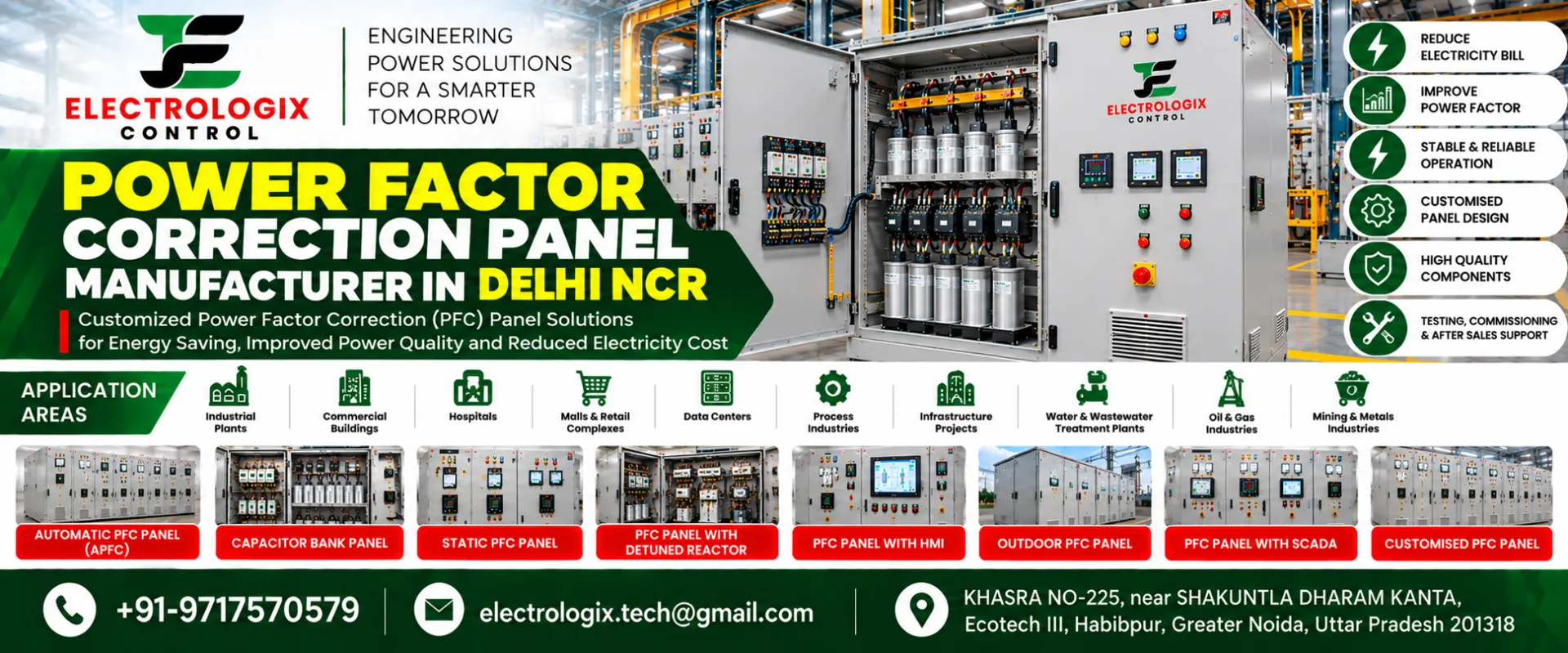
Electrologix Control System provides customized Power Factor Correction Panels in Delhi NCR for industrial, commercial and electrical distribution applications where improvement and control of power factor is required.
A power factor correction panel, commonly known as a PFC Panel, APFC Panel or Automatic Power Factor Correction Panel, uses capacitor steps and an automatic controller to compensate for reactive power associated with inductive loads. The controller measures the electrical system’s power factor and switches capacitor stages according to the operating requirement.
Power factor correction can help improve electrical system utilization and, depending on the utility tariff and installation, may help reduce power-factor-related charges. The actual benefit depends on the electrical load profile, utility tariff structure and overall system design.
Electrologix Control System focuses on application-specific panel engineering, appropriate capacitor-bank selection, switching arrangements, protection and practical panel construction for different electrical installations.
What Is a Power Factor Correction Panel?
A Power Factor Correction Panel is an electrical panel used to improve the power factor of an electrical system by supplying reactive power locally through capacitor banks.
Industrial facilities commonly operate motors, transformers, compressors, pumps, HVAC systems and other inductive loads. These loads can require reactive power in addition to active power.
A PFC panel provides controlled capacitive reactive power to compensate for part of this reactive demand.
An automatic PFC panel typically consists of:
- Power factor controller
- Capacitor banks
- Capacitor-duty contactors or suitable switching devices
- Protective devices
- Busbar system
- Current transformer
- HRC fuses or circuit protection
- Indication and control equipment
- Discharge arrangements
- Detuned reactors where required
- Enclosure and internal wiring
The final configuration depends on the electrical system, required kVAr capacity, harmonic conditions and project specifications.
What Is an APFC Panel?
An APFC Panel, or Automatic Power Factor Correction Panel, is a power factor correction panel that automatically switches capacitor stages according to the measured power factor and reactive power requirement.
Instead of keeping one fixed capacitor permanently connected, an APFC controller can switch different capacitor steps into or out of service as the electrical load changes.
This makes automatic correction particularly useful for facilities where electrical demand varies throughout the day.
Automatic capacitor banks are designed to compensate for varying reactive power requirements by switching capacitor modules according to changing load conditions.
How Does a Power Factor Correction Panel Work?
The basic operation of an APFC system is as follows:
- A current transformer measures the electrical current of the installation.
- The APFC controller evaluates the electrical parameters and power factor.
- The controller determines whether additional capacitive compensation is required.
- Appropriate capacitor stages are switched into the circuit.
- When the reactive power requirement decreases, unnecessary capacitor stages are disconnected.
- The controller continuously manages the available capacitor steps according to the configured operating logic.
This automatic switching allows the capacitor bank to respond to changing electrical loads.
Power Factor Correction Panel Manufacturer in Delhi NCR
Electrologix Control System designs and supplies Power Factor Correction Panels in Delhi NCR for applications requiring controlled reactive power compensation.
We can develop PFC and APFC panels based on parameters such as:
- System voltage
- Frequency
- Maximum demand
- Existing power factor
- Target power factor
- Required kVAr compensation
- Load profile
- Number of capacitor steps
- Harmonic distortion
- Transformer capacity
- Short-circuit level
- Installation environment
- Available panel space
Correct sizing is important because an inappropriate capacitor-bank configuration can result in under-correction, over-correction or undesirable system behavior.
Why Is Power Factor Correction Important?
Power factor is an important characteristic of an AC electrical system because it indicates the relationship between useful active power and the apparent power required by the system.
A lower power factor can result in higher current for a given active power requirement. Improving the power factor can reduce the reactive component of current and improve utilization of electrical distribution capacity.
Depending on the installation and utility tariff structure, maintaining an appropriate power factor may also help avoid power-factor-related charges.
Power factor correction is therefore commonly considered in:
- Manufacturing plants
- Process industries
- Commercial buildings
- Textile facilities
- Steel and engineering industries
- Cement plants
- Food processing units
- Pharmaceutical facilities
- Warehouses
- Shopping complexes
- Hotels
- Hospitals
APFC Panel for Industrial Applications
Industrial facilities frequently operate large numbers of motors and other inductive loads.
The reactive power requirement can change as motors and machinery start, stop or operate at different loads. An APFC panel can automatically switch capacitor steps according to the changing electrical requirement.
For industrial installations, APFC panel design may consider:
- Transformer capacity
- Maximum demand
- Motor load
- Load variation
- Existing power factor
- Harmonic levels
- Capacitor step size
- Switching frequency
- Required protection
- Future expansion
Electrologix Control System can develop the panel configuration according to the electrical characteristics of the specific facility.
Capacitor Bank for Power Factor Correction
The capacitor bank is the principal reactive power compensation element in a conventional PFC or APFC system.
A capacitor bank consists of multiple capacitor units or stages selected to provide the required reactive power compensation.
For an automatic system, these stages can be switched individually to match the changing reactive power demand.
Capacitor selection should take into account the system voltage, frequency, operating conditions, harmonic environment and required kVAr rating.
Capacitors also experience transient currents during energization, which is why appropriate switching equipment and capacitor-duty contactors or suitable switching technology are important considerations in PFC panel design.
APFC Panel With Detuned Reactors
In installations containing significant harmonic-producing loads, simply installing standard capacitors may not always be appropriate.
Loads such as variable frequency drives, UPS systems, soft starters, welders, power electronics and other nonlinear equipment can generate harmonics. Capacitors can interact with system inductances and potentially create resonance conditions.
For such applications, detuned reactor-based APFC panels may be considered.
A detuned reactor is connected in series with the capacitor stage to shift the system’s resonant behavior and reduce the risk of undesirable resonance.
Whether a detuned APFC system is required should be determined from the actual harmonic characteristics of the electrical network rather than assumed for every installation.
Types of Power Factor Correction Panels
Electrologix Control System can provide different PFC configurations according to application requirements.
Automatic Power Factor Correction Panel
An automatic PFC panel uses a controller to switch capacitor stages according to the measured power factor and reactive power requirement.
APFC Capacitor Panel
An APFC capacitor panel combines an automatic power factor controller with multiple capacitor stages and associated switching and protection equipment.
Fixed Capacitor Panel
A fixed capacitor arrangement provides a predetermined amount of reactive compensation and may be suitable for relatively stable loads.
Detuned APFC Panel
A detuned APFC panel incorporates reactors with capacitor stages for applications where harmonic conditions require additional consideration.
Harmonic Filter Panel
Where harmonic mitigation is a primary requirement, a harmonic filtering solution may be considered instead of a conventional PFC arrangement. System studies are recommended for harmonic-rich applications.
Key Components of an APFC Panel
A properly engineered APFC panel can include several important components.
APFC Controller
The controller monitors electrical parameters and manages the switching of capacitor stages.
Capacitor Bank
Capacitor stages provide the reactive power compensation required by the electrical system.
Capacitor Duty Contactors
Specialized switching devices may be used for controlling capacitor stages. Capacitor switching can produce high transient currents, making appropriate switching equipment important.
Current Transformer
A CT provides current information to the power factor controller so that the controller can evaluate system conditions.
Protection Devices
Appropriate circuit protection is incorporated according to the capacitor bank and electrical system design.
Detuned Reactors
Where required, reactors can be installed in series with capacitor stages to address harmonic and resonance considerations.
Busbar System
The busbar system distributes electrical power to the individual capacitor stages and associated equipment.
Enclosure
The enclosure is selected according to the installation environment and required electrical and mechanical characteristics.
Benefits of Power Factor Correction Panels
A properly designed power factor correction system can provide several electrical and operational benefits:
- Improves power factor
- Reduces reactive power demand from the upstream supply
- Can reduce line current associated with reactive demand
- Helps utilize transformer and distribution capacity more effectively
- Can help reduce power-factor-related utility charges where applicable
- Supports improved electrical system efficiency
- Provides automatic compensation for changing loads
- Helps maintain the configured power factor target
The actual energy and cost benefits depend on the facility’s load profile, tariff structure, electrical system and operating conditions.
Power Factor Correction Panel for Commercial Buildings
Commercial buildings may have significant inductive loads from:
- HVAC systems
- Pumps
- Elevators
- Chillers
- Air-handling units
- Large motors
- Refrigeration equipment
A suitable APFC panel can automatically compensate for changing reactive power requirements and support the building’s electrical distribution system.
The required capacitor capacity should be determined from the actual load and power factor data.
Power Factor Correction Panel for Manufacturing Plants
Manufacturing plants often have a combination of motors, transformers, welding equipment, drives and other electrical loads.
Because the load profile can change significantly during production, an automatic power factor correction system can provide more flexible compensation than a fixed capacitor arrangement.
For manufacturing applications, harmonic analysis may also be important before selecting capacitor banks, particularly where significant nonlinear loads are present.
Custom APFC Panel Manufacturer Delhi NCR
Every electrical system has a different load profile. Therefore, APFC panels should be sized and configured according to actual operating conditions.
Electrologix Control System can customize APFC panels based on:
- Existing power factor
- Desired operating power factor
- Transformer rating
- Maximum demand
- Connected load
- Required kVAr
- Number of steps
- Capacitor step size
- Harmonic levels
- System voltage
- Protection requirements
- Panel dimensions
- Installation conditions
Customers can provide electrical consumption data, a single-line diagram, transformer details or existing power-factor readings for technical evaluation.
How to Select the Right APFC Panel?
Selecting an APFC panel should begin with understanding the electrical system rather than selecting a capacitor size solely from the connected load.
Check the Existing Power Factor
Historical meter readings or power-quality measurements can help establish the existing operating condition.
Determine the Target Power Factor
The target should be selected according to the electrical system, utility requirements and operating objectives.
Determine Required kVAr
The required compensation depends on the active power, existing power factor and desired power factor.
Study Load Variation
If the load changes significantly throughout the day, an automatic multi-step APFC system may be more appropriate than a fixed capacitor arrangement.
Check Harmonic Levels
The presence of VFDs, UPS systems, welding equipment and other nonlinear loads should be considered before selecting capacitor banks.
Select Appropriate Switching Equipment
Capacitor switching produces transient currents, so switching components should be suitable for capacitor applications.
Consider Future Expansion
Where additional electrical loads are planned, the APFC system can be designed with suitable future expansion provisions where practical.
Power Factor Correction and Harmonics
Power factor correction and harmonic mitigation are related but different electrical functions.
A conventional capacitor bank is primarily intended to compensate reactive power. It is not automatically a harmonic filter.
In harmonic-rich electrical systems, capacitors can interact with system inductance and create resonance conditions. Manufacturers of power-quality equipment therefore provide anti-resonant and harmonic-filtering capacitor-bank configurations for such applications.
For facilities with substantial nonlinear loads, a power-quality assessment or harmonic study can help determine whether a standard APFC panel, detuned APFC panel or dedicated harmonic-filtering solution is appropriate.
Engineering and Manufacturing Approach
Electrologix Control System focuses on practical electrical engineering when developing PFC and APFC panels.
Our approach can include:
Electrical Assessment:
Understanding the load profile, power factor, transformer capacity and application requirements.
Capacitor Selection:
Determining suitable capacitor stages according to the required reactive power compensation.
Controller Configuration:
Selecting an appropriate automatic control arrangement for the required number of capacitor stages.
Protection:
Incorporating suitable protection according to the capacitor bank and electrical system.
Harmonic Consideration:
Evaluating whether detuned reactors or other harmonic-related measures may be required.
Panel Layout:
Arranging components to support practical operation, ventilation, inspection and maintenance.
Quality Considerations for APFC Panels
The reliability of an APFC panel depends on proper engineering and component selection.
Important considerations include:
- Correct capacitor ratings
- Suitable capacitor switching devices
- Appropriate protection
- Correct CT installation
- Proper controller configuration
- Adequate busbar capacity
- Thermal management
- Suitable enclosure
- Correct internal wiring
- Electrical clearances
- Proper earthing
- Inspection and testing
The final design should follow the applicable project specifications and relevant electrical standards.
Modern PFC capacitor-bank equipment is commonly designed with reference to standards such as IEC 61439 and IEC 61921, depending on the equipment type and application.
Why Choose Electrologix Control System?
Electrologix Control System provides customized electrical control and power-quality panel solutions for industrial and commercial applications.
Application-Based Design:
We consider the actual electrical requirements before determining the APFC configuration.
Customized Capacitor Bank:
Capacitor capacity and step arrangement can be developed according to the required compensation.
Harmonic Consideration:
Where nonlinear loads are present, harmonic conditions can be considered during the technical evaluation.
Practical Panel Engineering:
Component arrangement, protection, wiring and maintenance accessibility are considered during panel development.
Delhi NCR Service Coverage:
We support electrical projects across Delhi NCR and surrounding industrial areas.
Frequently Asked Questions
What is a Power Factor Correction Panel?
A Power Factor Correction Panel is an electrical panel that uses capacitor banks and associated control equipment to compensate reactive power and improve the power factor of an electrical system.
What is an APFC Panel?
An APFC panel is an Automatic Power Factor Correction Panel that automatically switches different capacitor stages according to the measured electrical requirement.
What is the difference between PFC and APFC panels?
A PFC system can refer generally to power factor correction using capacitors, while an APFC panel automatically controls multiple capacitor stages according to changing electrical conditions.
Who provides Power Factor Correction Panels in Delhi NCR?
Electrologix Control System provides customized PFC and APFC panel solutions for industrial, commercial and electrical distribution applications across Delhi NCR.
Why is a capacitor bank used in an APFC panel?
Capacitor banks provide capacitive reactive power that compensates for part of the reactive power demand created by inductive electrical loads.
Can an APFC panel improve electricity efficiency?
Power factor correction can reduce reactive current and improve utilization of the electrical distribution system. Depending on the utility tariff and installation, it may also reduce power-factor-related charges.
Is an APFC panel suitable for systems with VFDs?
It can be, but the harmonic environment should be evaluated before selecting the capacitor-bank configuration. VFDs and other nonlinear loads can introduce harmonics, which may create resonance concerns when capacitors are installed.
What information is required to design an APFC panel?
Useful information includes transformer capacity, maximum demand, existing power factor, target power factor, load profile, system voltage, harmonic conditions and available installation space.
Can Electrologix Control System manufacture customized APFC panels?
Yes. APFC panels can be customized according to required kVAr capacity, capacitor steps, system voltage, protection, controller configuration, harmonic conditions and installation requirements.
Get a Customized Power Factor Correction Panel
If you are searching for a Power Factor Correction Panel in Delhi NCR, Electrologix Control System can help evaluate your electrical system and develop a suitable PFC or APFC panel configuration.
Share your existing power factor, transformer rating, maximum demand, electricity bill data, load details, harmonic information or electrical single-line diagram with our technical team.
We can assess the available information and recommend an appropriate power factor correction approach for your application.